

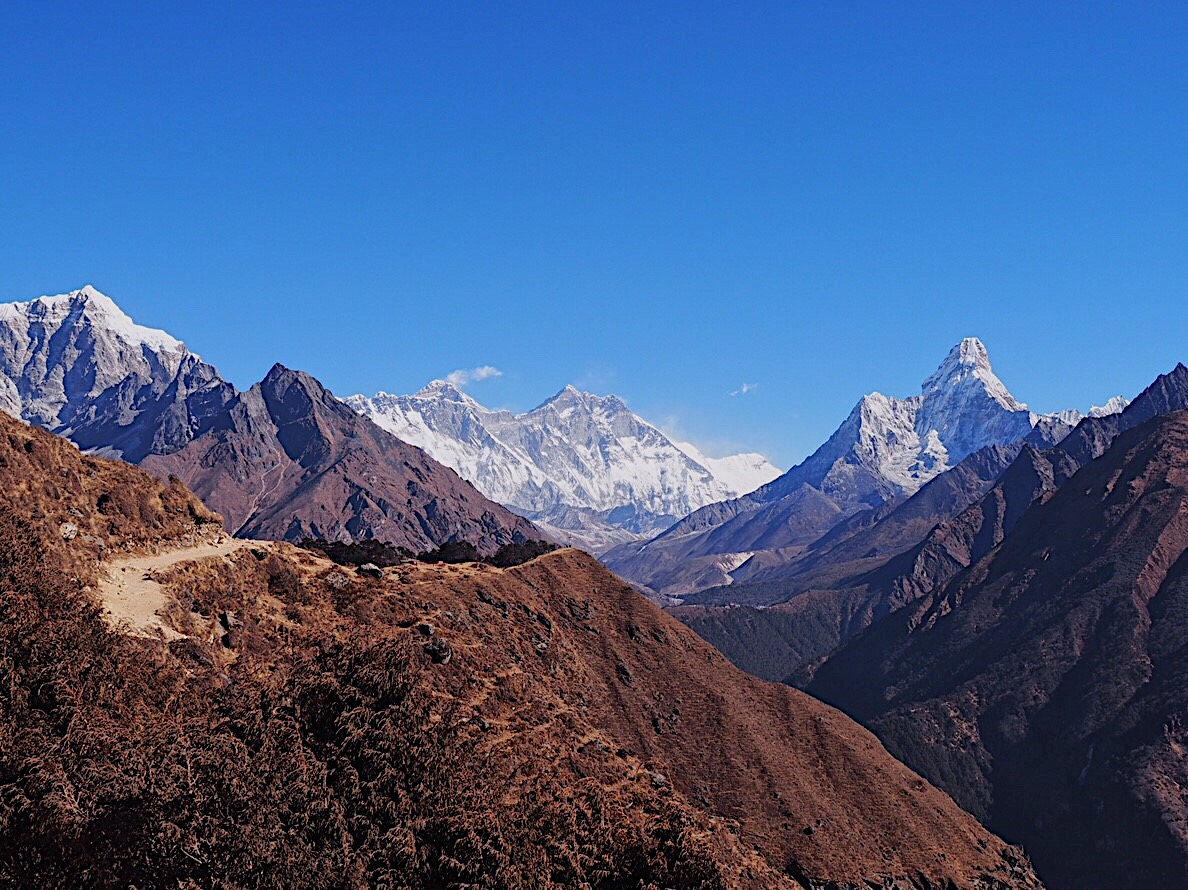
Mount Everest – The Majestic Roof of the World
Mount Everest, towering at an awe-inspiring height of 8,848.86 meters (29,031.7 feet), is the highest mountain on Earth. Straddling the border between Nepal and the Tibet Autonomous Region of China, Everest is a legendary peak that symbolizes adventure, challenge, and human endurance.
A Natural Wonder Like No Other
Known as “Sagarmatha” in Nepali and “Chomolungma” in Tibetan, Mount Everest is part of the Mahalangur Himal sub-range of the Himalayas. It was first summited on May 29, 1953, by Sir Edmund Hillary of New Zealand and Tenzing Norgay Sherpa of Nepal, an achievement that transformed global mountaineering forever.
Everest isn't just a mountain—it's a global icon. From seasoned mountaineers to casual trekkers and cultural explorers, millions are drawn to the mystery and majesty of this colossal peak.
Why Mount Everest is So Famous
🌍 Tallest Point on Earth: At nearly 9 kilometers above sea level, Everest is the highest place you can stand on the planet.
🏔️ Challenging Climb: Summiting Everest is considered the ultimate achievement for mountaineers.
🧗 Rich Mountaineering History: From the early British expeditions to modern-day alpine-style ascents, Everest has seen it all.
🎒 Everest Base Camp Trek: Even if you’re not aiming for the summit, the Everest Base Camp (EBC) trek offers stunning views and a life-changing adventure. We, Nepal Himalayas Trekking, have fixed departure with an affordable Trek Cost.
How to Experience Mount Everest
1. Everest Base Camp Trek
The Everest Base Camp Trek is the most popular way to experience the mountain’s grandeur up close. Starting from Lukla, trekkers journey through Namche Bazaar, Tengboche, and Gorakshep, reaching the iconic base camp at 5,364 meters.
Duration: 12–14 days, also known as the Everest Base Camp Trek 14 Days.
Difficulty: Moderate to Challenging
Best Time: Spring (March–May) and Autumn (September–November)
2. Summiting Mount Everest
For elite climbers, summiting Everest or an Everest Expedition is the ultimate goal, which is also known as Mount Everest Mountaineering two main climbing routes are:
South Col Route (Nepal side) – the most popular and accessible
North Ridge Route (Tibet side) – technically challenging and less crowded
3. Everest Helicopter Tour
Short on time? An Everest Helicopter Tour from Kathmandu offers panoramic views of Everest, Lhotse, Nuptse, and Ama Dablam—a luxurious way to witness the Himalayas.
Fun Facts About Mount Everest
🌡️ Temperatures on the summit can drop to -60°C (-76°F).
💨 Winds can exceed 200 km/h (125 mph) during the jet stream season.
🎒 Over 6,000 climbers have summited Everest since 1953.
🏔️ The mountain continues to rise by about 4 mm per year due to tectonic activity.
Mount Everest: More Than Just a Mountain
Everest is not just about altitude. It's also about the Sherpa culture, Buddhist monasteries, glacial rivers, and the awe-inspiring Khumbu Icefall. Whether you trek to its base, fly above its peak, or dream of standing on its summit, Mount Everest leaves a lasting impression on every soul it touches.
Planning Your Everest Adventure?
If you're looking to:
Trek to Everest Base Camp
Embark on a budget-friendly journey
Experience a luxury Everest helicopter tour
Or climb the summit of the world
Let us help you make your dream a reality. From itinerary planning to local guides, permits, and gear support, you’re in good hands.
Mount Everest - The Tallest Mountain in The World.
Mount Everest is the world's tallest mountain or peak of the world. It is also called Earth's highest mountain. Mount Everest lies in the between of Tibet (China) and Nepal. Mt Everest is also called in different way. In Nepali, we called Sagarmath & 15th (Pandrau chuli), which name was found by Baburam Acharya in 1955 & Pandrau Chuli was found by Radhanath Sikandhar, who is Indian citizen. And in English we called Mt Everest, which was found by British Surbeyor George Everest in 1865. North Part of Mount Everest lies in Tibet (China), which is 1 of 4th part and rest of other 3 part of Mt Everest lies in Nepal. IN the Tibetian (China) language we called Chomolungma (Zhūmùlǎngmǎ Fēng).
Where is Mount Everest
This world's highest mountain (Mt Everest) located in the Khumbu Mahalangur Himal sub range of the Himalays. Mount Everest elevation of 8,848.86 M was most recently established in 2020 by the Chinese and Nepali Government. Mount Everest also called Holy Mother and listing in the Thousand Himalayas. According to the Wikipedia, there is some real facts of Mt Everest.
Elevation: 29,032′ (8848.86 M high from sea level)
First ascent: May 29, 1953
Prominence: 29,029′
Location: Solukhumbu District, Province No. 1, Nepal; Tingri County, Xigazê, Tibet Autonomous Region, China
Anime: The Summit of the Gods indiewire.com
Mount Everest First Climber
First ascenders: Edmund Hillary, Tenzing Norgay (Those are mt Everest climbers)
Mountain range: Himalayas, (KHUMBU) Mahalangur Himal
In the Mount Everest climbing history, Sir Edmund Hillary from New zealand, & Tenzing Norgay Sherpa from Nepal are the first submitter of Mt Everest, 29th May, in 1953. And first women (Female) called MRS Junko Tabei from Japan climbed Mt Everest, 16th May, in 1975. She is a first women mount Everest climber. And then from different country people found or represented as a different way. There are more than 4/5 name from different country, which are already mentioned an above.
We Nepal Himalayas Trekking would like to advice if you are going to travel in Nepal and interesting to do some activities in Everest region and then before to go Everest region, Mount Everest climber & Everest region traveller have to know some things about Mount Everest.
Mount Everest Facts
- Mount Everest also called Sagarmath in Nepali language & Chomolungma in Tibet (Chainese) language.
- Mt Everest is the tallest mountain or peak of the world. It is also called earth's biggest mountain.
- Mount Everest Elevation is 29032' or height is 8848.86 M from sea level.
- Mount Everest was first climbed in 1953.
- Mount Everest first summiter or climbers are (Sir Edmund Hillary from New zealand & Tenzing Norgay Sherpa from Nepal / India) in 1953.
- Mount Everest rises 40 CM per Century.
- Mount Everest is about 60 million years old.
- Mount Everest is called 15th Chuli (Pandhrau) before to give Mt Everest name by British Surveyor George Everest in 1865.
- Mount Everest has been summited over 9000 times already and it increase in every year.
- In Everest region, Sherpa are the only people, who can climb Mt Everest without oxygen.
- There is always a " 2 o 'clock rule when climbing Mt Everest.
- More than 300 people have died on Mount Everest.
- We need more than 10 weeks and around $ 35000 USD to climb Mt Everest.
- Helicopters can't fly to the top of Mount Everest.
- Mount Everest belongs to in Nepal and Tibet (China) part. Third of fourth part lies in Nepal & one of fourth part lies in Tibet.
- Reinhold Messner from Italian the first solo ascent of Mount Everest and, along with Peter Habeler, the first ascent of Everest without supplemental oxygen.
- Mount Everest top length is 7 M & covered 7 square M.
Mount Everest Temperature
Mount Everest Climbers want to know the Mount Everest temperature before to climb Mt Everest and Everest base camp trek in Everest region. Many climbers asked such following way for Mt Everest temperature
- How cold does it get on top of Mount Everest?
The climate & weather of Mount Everest is one of extremes. Temperatures at the summit are never above freezing and during January temperatures can drop as low as -60° C (-76° F). Despite the low temperatures the biggest issue faced by climbers are hurricane force winds and wind chill.
- How cold is the death zone?
Temperatures in the death zone never rise above zero degrees Fahrenheit. "Any exposed skin freezes instantly," Burke said. A loss of blood circulation to climbers' fingers and toes can cause frostbite, and in severe cases — if the skin and underlying tissues die — gangrene.
Mount Everest base camp or Everest base camp trek weather and temperatures always changeable in different season and in different months. Normally
- In winter season (January to February): There is very cold weathers and temperatures goes (4 degree centigrate to -17 degree centigrate) from day to night.
- In spring season (March to May): There is quite good weather. We have found not much cold and not hot too. Temperatures goes ( 15 degree centigrate to -12 degree centigrate) from day to night.
- In Monsoon / raining season (June to August): Weather seems to fuggy but doesn't cold and temperatures goes (17 degree centigrate to 5 degree centigrate) from day to night.
- In Autumn season ( September to December): We have found good weather. At that time many tourists want to do different activities and temperatures goes (12 degree centigrate to - 15 degree centigrate) from day to night.
Mount Everest Climbers
A. Sir Edmund Hillary & Tenzing Norgay Sherpa were the first climbers to reach the summit.
B. Ang Rita Sherpa, the most well known Mt Everest climber Sherpa than others.
C. Sherpas had Summitted Mt Everest many more times than westerners.
D. Juerg P. Marmet is a third person to climb Mt Everest from Nepal. He was climbed May 23, 1956.
Here is some list of Mount Everest Climbers
| Numbers | Name Of Climbers | Nationality | Gender | Age | Date | Route | Occupation |
|---|---|---|---|---|---|---|---|
| 1 | Edmund Percival Hillary | New Zealand | M | 33 | May 29, 1953 | S Col-SE Ridge | Apiarist & alpinist |
| 2 | Tenzing Norgay | India | M | 39 | May 29, 1953 | S Col-SE Ridge | |
| 3 | Juerg P. Marmet | Switzerland | M | 28 | May 23, 1956 | S Col-SE Ridge | Engineer (oxygen expert) |
| 4 | Ernst Schmied | Switzerland | M | 31 | May 23, 1956 | S Col-SE Ridge | Business executive |
| 5 | Adolf (Dolf) Reist | Switzerland | M | 35 | May 24, 1956 | S Col-SE Ridge | Photographer & aircraft mechanic |
| 6 | Hans-Rudolf Von Gunten | Switzerland | M | 27 | May 24, 1956 | S Col-SE Ridge | Chemist |
| 7 | Gombu (Konbu) | China | M | 25 | May 25, 1960 | N Col-NE Ridge | |
| 8 | Ying-Hua Qu | China | M | 25 | May 25, 1960 | N Col-NE Ridge | |
| 9 | Fu-Chou Wang | China | M | 24 | May 25, 1960 | N Col-NE Ridge | |
| 10 | James W. (Jim) Whittaker | USA | M | 34 | May 1, 1963 | S Col-SE Ridge | Manager, Recreational Equipment Inc, Seattle retail co-op |
| 11 | Nawang Gombu (1/2) | India | M | 26 | May 1, 1963 | S Col-SE Ridge | Instructor, Himalayan Mountaineering Institute |
| 12 | Barry Chapman Bishop | USA | M | 31 | May 22, 1963 | S Col-SE Ridge | Photographer & geographer, National Geographic Society |
| 13 | Luther Gerald (Lute) Jerstad | USA | M | 26 | May 22, 1963 | S Col-SE Ridge | Speech instructor, University of Oregon alpine guide |
| 14 | Thomas Frederick Hornbein | USA | M | 32 | May 22, 1963 | W Cwm-W Ridge-N Face up; SE Ridge-S Col down | Physician (anesthesiologist) |
| 15 | William Francis (Willi) Unsoeld | USA | M | 36 | May 22, 1963 | W Cwm-W Ridge-N Face up; SE Ridge-S Col down | University professor of philosophy & religion, deputy director |
| 16 | Autar Singh Cheema | India | M | 27 | May 20, 1965 | S Col-SE Ridge | Major, Indian Army |
| 17 | Sonam Gyatso | India | M | 42 | May 22, 1965 | S Col-SE Ridge | |
| 18 | Sonam Wangyal | India | M | 23 | May 22, 1965 | S Col-SE Ridge | |
| 19 | Ang Kami Sherpa | India | M | 0 | May 24, 1965 | S Col-SE Ridge | |
| 20 | C. P. Vohra | India | M | 30 | May 24, 1965 | S Col-SE Ridge | |
| 21 | Hari Pal Singh Ahluwalia | India | M | 27 | May 29, 1965 | S Col-SE Ridge | Captain, Indian Army |
| 22 | Harish Chandra Singh Rawat | India | M | 30 | May 29, 1965 | S Col-SE Ridge | |
| 23 | Phu Dorje Sherpa (Khumjung, 1937) | Nepal | M | 27 | May 29, 1965 | S Col-SE Ridge | |
| 24 | Teruo Matsuura | Japan | M | 36 | May 11, 1970 | S Col-SE Ridge | |
| 25 | Naomi Uemura | Japan | M | 29 | May 11, 1970 | S Col-SE Ridge | |
| 26 | Katsutoshi Hirabayashi | Japan | M | 35 | May 12, 1970 | S Col-SE Ridge | |
| 27 | Chotare Sherpa (Namche Bazar, 1932) | Nepal | M | 37 | May 12, 1970 | S Col-SE Ridge | |
| 28 | Rinaldo Carrel | Italy | M | 21 | May 5, 1973 | S Col-SE Ridge | Alpine guide |
| 29 | Mirko Minuzzo | Italy | M | 26 | May 5, 1973 | S Col-SE Ridge | Alpine guide |
| 30 | Lhakpa Tenzing Sherpa (Namche Bazar, 1940) | Nepal | M | 32 | May 5, 1973 | S Col-SE Ridge | |
| 31 | Shambu Tamang (Lisankhu, 1955) (1/2) | Nepal | M | 17 | May 5, 1973 | S Col-SE Ridge | |
| 32 | Claudio Benedetti | Italy | M | 27 | May 7, 1973 | S Col-SE Ridge | Alpine & ski instructor in Military School of Aosta |
| 33 | Virginio Epis | Italy | M | 41 | May 7, 1973 | S Col-SE Ridge | Alpine & ski instructor in Military School of Aosta |
| 34 | Fabrizio Innamorati | Italy | M | 30 | May 7, 1973 | S Col-SE Ridge | Ski & alpine instructor in the Military School |
| 35 | Sonam Gyaltzen Sherpa (Bagam, 1943) | Nepal | M | 29 | May 7, 1973 | S Col-SE Ridge | |
| 36 | Hisashi Ishiguro | Japan | M | 28 | Oct 26, 1973 | S Col-SE Ridge | Office worker |
| 37 | Yasuo Kato (1/3) | Japan | M | 24 | Oct 26, 1973 | S Col-SE Ridge | Student of university |
| 38 | Ms. Junko Tabei | Japan | F | 35 | May 16, 1975 | S Col-SE Ridge | Housewife |
| 39 | Ang Tshering Sherpa (Namche Bazar, 1949) | Nepal | M | 25 | May 16, 1975 | S Col-SE Ridge | |
| 40 | Da Phuntsok (Darphuntso) | China | M | 30 | May 27, 1975 | N Col-NE Ridge | |
| 41 | Kunga Pasang (Gonga Basang) | China | M | 27 | May 27, 1975 | N Col-NE Ridge | |
| 42 | Lhotse (Louze) | China | M | 36 | May 27, 1975 | N Col-NE Ridge | |
| 43 | Ngapo Khyen (Abu Qin) | China | M | 18 | May 27, 1975 | N Col-NE Ridge | |
| 44 | Ms. Phantog (Phandu, Pando) | China | F | 36 | May 27, 1975 | N Col-NE Ridge | |
| 45 | Samdrup (Samdruk) | China | M | 22 | May 27, 1975 | N Col-NE Ridge | Alpinist |
| 46 | Sonam Norbu | China | M | 28 | May 27, 1975 | N Col-NE Ridge | |
| 47 | Tsering Tobgyal | China | M | 0 | May 27, 1975 | N Col-NE Ridge | |
| 48 | Sheng-Fu Hou | China | M | 35 | May 27, 1975 | N Col-NE Ridge | |
| 49 | Dougal Haston | UK | M | 33 | Sep 24, 1975 | SW Face-S Smt | Director of International School of Mountaineering, Leysin |
| 50 | Douglas Keith (Doug) Scott | UK | M | 34 | Sep 24, 1975 | SW Face-S Smt | School teacher, wri |