
Everest Base Camp Trek Highlights: What You'll See on the Way
I've walked the trail to Everest Base Camp more times than I can count. Probably over 200 by now. And the strange thing is that it still gets me.
You'd think that after a while, the views become routine. They don't. There's a moment on day four, walking up out of Namche Bazaar, when Everest pokes out from behind a ridge for the first time, and I still stop. Every trekker behind me stops too, usually without being told. Nobody says anything for a minute. Then somebody whispers, "That's it?" and somebody else says, "That's it."
That's what this trek is really about. It's not the physical achievement, though that's real. It's the sequence of moments that hit you one after the other for two weeks. So if you're planning the Everest Base Camp Trek for 2026 or 2027 and want to know what you'll actually see along the way, here's the honest answer from somebody who's been there a few hundred times.
1. The Lukla Flight (Day 1)
Before you take a single step on the trail, you've already done one of the most talked-about parts of the trek.
The 35-minute flight from Kathmandu (or from Manthali in spring and autumn) into Lukla is short, loud, and shaky in a small twin-engine Otter or Dornier. Then the runway appears, which is short, sloped uphill, and dead-ends in a stone wall against the mountain. You're not allowed to be nervous; the pilots make this landing four times a day in good weather.
Most trekkers come off that plane laughing. Some are pale. A few want to do it again. Everyone has photos.
If the flight worries you, our Everest Base Camp Trek by Road skips Lukla entirely; you drive to Salleri and trek up from there.
2. The Suspension Bridges Over the Dudh Kosi (Day 2)
Six of them, give or take, on the walk from Phakding to Namche Bazaar. Long ones. Swaying ones. Decorated with prayer flags faded by twenty years of mountain weather.
The famous one is the Hillary Bridge, which sits about an hour below Namche, 125 metres above the river. People who claim they're fine with heights find out, on this bridge, whether that's actually true.
You'll cross these bridges single file, with porters going past you carrying impossible loads, with yaks coming the other way (always step to the uphill side where they don't stop, and if you're on the downhill side, you go in the river). It sounds dramatic. It's just the daily commute up here.
3. Namche Bazaar (Day 2 onwards)
Namche is the Sherpa capital. It's an amphitheatre of teahouses and shops carved into a horseshoe-shaped hillside at 3,440 metres, and it appears suddenly, and you climb for two hours uphill out of the river gorge, and then there it is, an entire town that wasn't visible until you were on top of it.
You'll spend two nights here on a standard 14-day itinerary, because this is where your first big acclimatisation rest happens. People grumble about the rest day until they have it, and then most of them are grateful by the time they leave for Tengboche.
Things to do in Namche on a rest day:
-
Walk up to the Sherpa Culture Museum and the Sagarmatha Next centre
-
Hike up to the Everest View Hotel for your first proper sit-down with the mountain
-
Drink coffee at the Bakery Café (yes, the cinnamon rolls are real, no, they're not cheap)
-
Buy anything you forgot to pack (Namche has more outdoor shops than most Kathmandu streets)
Honestly, of all the stops on the trail, Namche is the one most trekkers ask if they can come back to. We get emails about it.
4. The First View of Everest (Day 2 or Day 3)
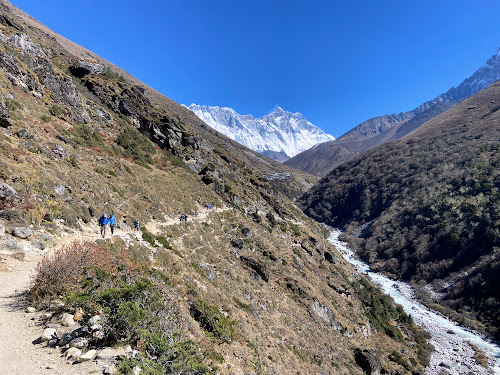
Somewhere between the climb out of Jorsale and the first acclimatisation walk above Namche, you see it. Not Everest the whole way — just the summit pyramid poking up behind the Nuptse-Lhotse wall. Smaller than you expect. Quieter than you expect.
People react in different ways. Some cry. Some take 80 photos in two minutes. Some just sit down on a rock and look at it.
This is the moment most first-time trekkers stop pretending the trek is just about the physical challenge. It isn't. It's about seeing this mountain with your own eyes, after years of seeing it in photos. There's no substitute for that.
If you only want this view and don't want to push to Base Camp itself, our Everest View Trek is built around this exact moment, 7 days, maximum altitude 3,880 m, no high-altitude risk.
5. Tengboche Monastery (Day 4)
The biggest active Buddhist monastery in the Khumbu, perched on a saddle at 3,860 m with Ama Dablam directly behind it. Walk through the door, take your shoes off, sit quietly on the floor along the wall. If you arrive at the right time early morning or late afternoon, the monks will be doing their puja, a low hypnotic chanting that goes for an hour with horns and drums.
You don't have to be Buddhist for this to mean something. Most trekkers I've taken inside come out quieter than they went in.
The monastery was rebuilt after a fire in 1989 (and an earlier earthquake before that), and there's a small museum next door with photos of the original 1916 structure. Worth twenty minutes.
6. Ama Dablam (Day 4 onwards)
Forget Everest for a second. The most beautiful mountain on this trek and arguably the most beautiful mountain in the world is Ama Dablam.
It's 6,812 metres of perfect pyramid, with two arms reaching out toward the trail like it's protecting something. Ama Dablam means "mother's necklace" in Sherpa, the hanging glacier on the south face is the dablam, the sacred pendant a Sherpa mother wears.
You'll see it for five full days of the trek. From Tengboche it looks like a postcard. From Dingboche it looms over the village like a sentinel. From the trail to Lobuche, it slips behind you and you keep turning around to catch one more look.
A lot of trekkers tell me, at the end of the trek, that Ama Dablam was the mountain that stuck with them, not Everest. I get it.
7. The Sherpa Villages — Pangboche, Pheriche, Dingboche (Days 4–6)
Above Tengboche, the forest disappears, and the trail enters Sherpa farming country. These aren't tourist villages built for the trek, they're 400-year-old high-altitude communities that happen to also host teahouses.
Pangboche has the oldest monastery in the Khumbu, and a relic locals will tell you (politely, with a straight face) is a yeti scalp. You can see it for a small donation.
Pheriche is a strip of teahouses on a windy flat at 4,371 m, with the famous Himalayan Rescue Association aid post where they run a free altitude sickness talk every afternoon at 3 PM. Go to it. Even if you feel fine. Especially if you feel fine.
Dingboche is the highest farming village in the world. Walls of stacked stone divide every tiny field, the wind would otherwise tear the barley out of the ground. You'll spend your second rest day here.
For a slower, more village-focused experience of these places, the EBC Premium Trek stays in better lodges in these villages, and our EBC Luxury Trek uses Yeti Mountain Home properties with proper heated rooms.
8. The Wildlife of Sagarmatha National Park (Throughout)
Most trekkers don't expect to see animals up here. They do.
-
Himalayan tahr — wild mountain goats with shaggy coats, grazing on the slopes above the trail
-
Musk deer — small, shy, fox-like; you'll usually only catch a glimpse in the forests below Tengboche
-
Danphe pheasant (the Himalayan monal) — Iridescent green and copper, Nepal's national bird, hard to miss when it appears
-
Snow pigeons in huge flocks circling the valleys
-
Golden eagles and Lammergeiers (bearded vultures) above the higher villages
-
Yaks and naks — domesticated, technically not "wildlife" but you'll see hundreds and they're the actual reason the entire trekking economy works
I have seen snow leopards exactly twice in fifteen years of guiding. Both times above Dingboche, both times at dusk. They're up there. You almost certainly won't see one. But it matters that they're there.
9. The Khumbu Glacier (Day 7)
Above Lobuche the trail climbs onto the lateral moraine of the Khumbu Glacier and you walk along its edge for the rest of the way to Gorak Shep.
A glacier from a postcard is one thing. Walking next to a real, alive, groaning glacier is another. You can hear it. Ice cracks. Rocks fall. Underneath the rubble surface, the ice is constantly moving for about a metre a day in some sections.
The Khumbu is the highest glacier in the world. The ice you're walking next to fell as snow on the slopes of Everest forty or fifty years ago.
10. The First View of the Khumbu Icefall (Day 7)
About two hours below Gorak Shep, you round a corner and the upper Khumbu opens up in front of you. The Icefall, the broken, chaotic frozen river of ice tumbling down from the Western Cwm is right there.
This is where climbing Everest actually starts. Every climber who summits Everest from the south side goes through this icefall, usually in the dark, usually before dawn, because by midmorning the sun loosens the ice and seracs collapse without warning.
You won't go into the icefall. You'll just stand there and look at it. And it's enough.
11. Everest Base Camp Itself (Day 8) — 5,364 m
This is the moment you came for.
The reality of it surprises most trekkers. There's no view of Everest from Base Camp itself, the summit is hidden behind the Nuptse-Lhotse wall. What there is: a chaos of glacial rubble, prayer flags strung between rocks, a small spray-painted boulder that says Everest Base Camp 5364 m, and in April and May, a tent city of expedition climbers preparing for their summit pushes.
Out of climbing season (June to March), Base Camp is just rock and prayer flags, and somehow that's better. Quieter. More yours.
You'll spend maybe an hour there. You'll take the photo with the rock. You'll see your guide quietly tie a prayer flag for somebody he lost up here. You'll walk back to Gorak Shep tired and changed.
A full breakdown of what each EBC package costs is in our Everest Base Camp Trek Cost guide for 2026/2027 — but no number really captures this moment.
12. Kala Patthar Sunrise (Day 9) — 5,545 m
Here's the part nobody tells you: the actual best view of Everest on this entire trek isn't from Base Camp. It's from Kala Patthar, the rocky ridge you climb the morning after Base Camp.
You'll get up at 4 AM. It will be dark. It will be cold like minus 15, sometimes minus 25 with wind chill. You'll trudge up a steep rocky slope for about two hours with a headlamp on, breathing like you're underwater.
And then you'll be standing on the highest point you'll reach on this trek, watching the sun hit the summit of Everest first, then Nuptse, then Lhotse, then Pumori behind you, then finally the village of Gorak Shep below.
This is the photograph. This is the postcard. This is the view you'll show your grandchildren.
If Kala Patthar is the main reason you want to do this trek, look at our EBC and Kala Patthar Trek which is specifically built around getting you here at sunrise in good condition.
13. The Faces of Lhotse, Nuptse, and Pumori (Days 6–9)
People come for Everest. They leave talking about its neighbours.
Lhotse (8,516 m) is the fourth-highest mountain in the world, but from the trail you see it as a single immense wall of ice and rock that dominates the entire upper valley. The south face of Lhotse is, by reputation, the hardest big-mountain wall on Earth.
Nuptse (7,861 m) sits in front of Everest from the Base Camp side, it's the reason you can't see Everest from Base Camp itself. From Kala Patthar, you see Everest peek over Nuptse's shoulder.
Pumori (7,161 m) sits directly above Kala Patthar. Pumori means "unmarried daughter" in Sherpa, George Mallory named it. From the ridge, it looks like a vertical wall of ice tilted forward, threatening to fall on you.
For a fuller experience of the high Khumbu peaks, our EBC and Gokyo Valley Trek crosses the Cho La pass and gives you the views from the other side of the range too.
14. The Night Sky from Gorak Shep (Day 8)
I almost didn't put this on the list, because half the trekkers I take up there are too tired and too cold to stand outside at night. But the ones who do, they remember it.
At 5,164 metres, with no light pollution, in dry winter air, the night sky over Gorak Shep is the clearest you'll ever see. The Milky Way is a band, not a smudge. Satellites are visible. Shooting stars are routine.
Bring your warmest jacket. Step outside the teahouse for ten minutes after dinner. Look up.
15. The Yak Caravans (Throughout)
This is the one nobody puts on highlights lists. They should.
Up here, everything like every bottle of beer in every teahouse, every gas cylinder, every roll of toilet paper, every climbing rope going to Base Camp, is carried up either by porters or by yaks. You'll pass these caravans every single day. Forty yaks at a time, bells clanging, a single Sherpa herder walking behind with a slingshot.
There's a rhythm to it that ties this whole trek together. The Khumbu economy walks past you, in the form of these animals, every hour you're up here. It's worth paying attention to.
When to Go to See These Highlights at Their Best
The two windows are late March to mid-May (spring) and late September to mid-November (autumn).
Spring gives you rhododendron blooms in the lower valleys (Lukla to Tengboche), warmer afternoons, and the expedition tent city at Base Camp. The downside is hazier views above 4,000 m as the day warms up.
Autumn gives you the clearest skies of the year , the most photographers come in October for this reason and the post-monsoon greenery on the lower trails. The downside is cold (it starts dropping fast by mid-November) and no climbers at Base Camp.
For a full month-by-month breakdown, we have a Best Time and Difficulty guide that goes through each season honestly.
A Note on Permits and Logistics
To trek anywhere in the Khumbu in 2026/2027 you'll need two permits the Sagarmatha National Park Entry Permit (NPR 3,000) and the Khumbu Pasang Lhamu Rural Municipality Permit (NPR 3,000). A licensed guide is mandatory; solo unguided trekking has been illegal since April 2023, and enforcement is strict now.
We handle all the paperwork for every client. The full picture is in our Nepal Trekking Permits 2026/2027 guide.
Some Useful External Reading
For trekkers who want to go deeper on the technical and cultural background, a few honest external resources:
-
Sagarmatha National Park (UNESCO World Heritage) — official UNESCO listing of the park, with the formal cultural and natural heritage citations
-
Himalayan Rescue Association — the people who run the Pheriche aid post; their altitude sickness reading is the best free resource on AMS prevention
-
Nepal Tourism Board — official source for permit information and current trekking regulations
-
Trekking Agencies' Association of Nepal (TAAN) — the body we're registered with; their site verifies licensed operators
Which EBC Package Hits the Most Highlights?
Honestly, all of them include the core sights from Lukla to Base Camp to Kala Patthar. The differences are about how comfortably you experience them, how much time you have at each stop, and whether you trek both directions or fly out by helicopter at the top.
Quick guide based on what most trekkers ask us for:
-
Want the classic experience, all 15 highlights, two weeks: Everest Base Camp Trek 14 Days
-
Same highlights, but skip the long walk down: EBC with Helicopter Return
-
Same highlights, in better lodges: EBC Luxury Trek
-
Add a high pass and Gokyo Lakes: EBC and Gokyo Valley Trek
-
For experienced trekkers — three passes, the full Khumbu: Everest Three Passes Trek
-
Limited time, see the highlights from the air: EBC Helicopter Tour
-
Want the views but not the altitude: Everest View Trek
A full price comparison is in our Everest Base Camp Trek Cost 2026/2027 breakdown.
Plan Your 2026 or 2027 Trek With Us
We've been running treks to Everest Base Camp since 2013. Our team at Nepal Himalayas Trekking is TAAN-registered, our guides are government-licensed and insured, and we won the TripAdvisor Travellers' Choice award in 2025.
If you've read this far, you're serious. The next step is just a conversation — tell us your dates, your fitness, and what you most want to see, and we'll send you a real itinerary with honest pricing.I read every enquiry myself and reply within an hour during Nepal working hours. No call centre. No pressure.







Add Your Comment