
Any Question? Email Us
info@nepalhimalayastrekking.comTalk To An Expert ( Prakash Lamsal )
Any Question? Email Us
info@nepalhimalayastrekking.comTalk To An Expert ( Prakash Lamsal )
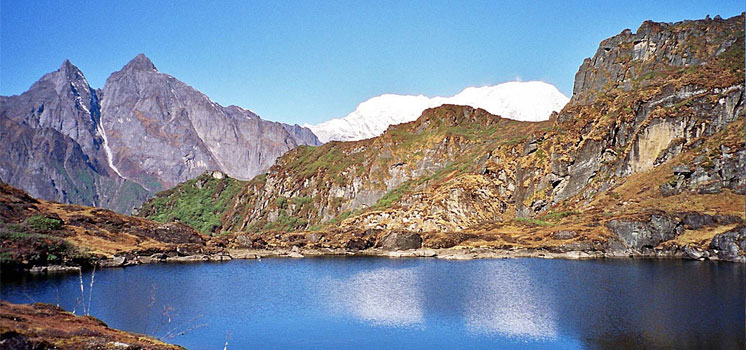
Quick Answer: The Makalu Base Camp Trek is a 18–19 day wilderness journey in eastern Nepal that leads to the foot of Mount Makalu (8,485m), the world's fifth-highest mountain, reaching a maximum altitude of 4,870m/15,977ft. Nepal Himalayas Trekking runs this Makalu Trek for USD 2,090–2,490 per person depending on group size, departing year-round with guaranteed dates in spring (March–May) and autumn (September–November). The trek is led personally by senior guide Prakash Lamsal, who has 12+ years of experience guiding in the Eastern Himalaya.
If you've already searched "Everest Base Camp crowded" or "Annapurna Circuit too touristy," you've found the right page. Nepal's tourism boards and trekking associations have flagged Makalu Base Camp Trek as one of the country's defining off-the-beaten-path treks for 2026 and 2027 — a route that delivers Everest-grade Himalayan scenery without the queues at teahouses or the crowded suspension bridges of the Khumbu.
Mount Makalu rises to 8,485 meters on the Nepal–Tibet border, just 19 kilometers east of Everest, yet receives a fraction of the visitors. Where Everest Base Camp sees hundreds of trekkers a day in peak season, Makalu Base Camp Trek routes typically host a few dozen — a genuine wilderness Makalu Expedition through one of the last untouched corners of the Nepal Himalayas.
This guide from Nepal Himalayas Trekking gives you the real 2026/2027 numbers: updated permit fees, an honest day-by-day itinerary, current trek cost, and the practical details most blogs skip. It's also a route we know personally — our lead guide Prakash Lamsal has walked this trail more times than he can count, and the contact details on this page reach him directly.
| Detail | Information |
|---|---|
| Trek Duration | 18–19 Days (Kathmandu to Kathmandu) |
| Max Altitude | Makalu Base Camp, 4,870m / 15,977ft |
| Trek Grade | Strenuous / Challenging |
| Starts/Ends | Kathmandu |
| Region | Eastern Nepal, Sankhuwasabha District |
| Best Season | Spring (March–May) & Autumn (September–November) |
| Group Size | 2–10 (private and group departures available) |
| Accommodation | 3-star hotel in Kathmandu; teahouses/lodges and camping on trail |
| Total Trekking Distance | Approx. 150–170 km round trip |
| Daily Walking Hours | 5–8 hours |
| Trek Cost 2026/2027 | From USD 2,090 per person (group), up to USD 2,490 (solo) |
The Makalu Base Camp Trek is the signature hiking adventure of eastern Nepal — a journey into the Makalu-Barun National Park that combines the raw mountaineering drama of a Himalayan base camp trek with deep, undiluted Sherpa, Rai, and Limbu cultural immersion.
Unlike treks that build gradually from busy lowland towns, the Makalu Base Camp Trekking route begins with a short scenic flight from Kathmandu to Tumlingtar, dropping you straight into the foothills of the eastern Himalaya. From there, the trail climbs through cardamom farms, bamboo and rhododendron forest, and traditional villages before crossing four high passes — Khongma La, Sano Pokhari Danda, Shipton La, and Keke La — each above 3,800 meters, with sweeping views of Makalu, Chamlang, Baruntse, and on clear days, Everest and Lhotse.
The Makalu-Barun National Park, established in 1992 and spanning roughly 1,500 square kilometers, is one of the most biodiverse protected areas in the Himalaya. Its altitude gradient runs from subtropical forest below 1,000 meters to glacial terrain above 8,000 meters — all inside one park boundary — making it home to red pandas, snow leopards, Himalayan tahr, and over 400 recorded bird species.
This is a trek for people who have already done a "classic" Himalayan trek and want something wilder. It's also, increasingly, a trek for first-timers who did their research and decided to skip the crowds entirely. Either way, you'll stand at the base of the world's fifth-highest mountain having shared the trail with a fraction of the foot traffic you'd find on Everest or Annapurna routes.
Arrival at Tribhuvan International Airport, where a Nepal Himalayas Trekking representative meets you and transfers you to your hotel in Thamel. Evening briefing available with your trek coordinator. Accommodation: 3-star hotel, Kathmandu
Meet your guide for a full briefing on the Makalu Expedition route, gear check, and permit processing (Makalu-Barun National Park permit and TIMS card). Optional guided tour of Kathmandu's UNESCO World Heritage Sites — Swayambhunath, Boudhanath, and Pashupatinath. Accommodation: 3-star hotel | Meals: Breakfast
A 30–35-minute mountain flight to Tumlingtar, followed by a scenic 3–4 hour jeep drive through Khandbari to Num — the last roadhead before the trek begins on foot. Accommodation: Teahouse | Meals: B, L, D | Drive: 40km, 3–4 hrs
A steep descent to the Arun River, crossing a suspension bridge, then a long climb to Seduwa through bamboo forest. Permit check at the Makalu-Barun National Park entry gate. 8km | 5–6 hrs
Through rhododendron forest and Sherpa farmland, with a gradually steepening trail to the last permanent village before the high country. 8km | 5–6 hrs
A demanding climb through dense rhododendron forest, gaining nearly 1,400 meters in elevation. 7.2km | 5–6 hrs
A short, essential acclimatization hike up toward Khongma La (3,890m) to aid adjustment before the multi-pass crossing ahead.
The signature day of the trek: crossing Khongma La (3,890m), Sano Pokhari Danda (4,105m), Shipton La (4,200m), and Keke La (4,170m) in succession, with continuous views of Makalu and Chamlang. 7.6km | 6–7 hrs
A gentler day descending through forest before following the Barun Khola upstream into open meadow country. 9.7km | 5–6 hrs
The valley opens up dramatically, with Peak 4, Peak 6, Peak 7, and Mera Peak visible ahead — a visually overwhelming day. 10.5km | 5–6 hrs
The final push to base camp, passing Shershong (4,630m) before the world's fifth-highest mountain fills the skyline. 8.7km | 5–6 hrs
An acclimatization and exploration day — hike toward the ridge above base camp (around 5,300m) for panoramic views of Makalu, Everest, Lhotse, and Nuptse, or take a gentler walk to the nearby glacial lakes.
Retracing your steps through Shershong and Langmale. 16km | 7–8 hrs
9.3km | 6–7 hrs
Your final high-altitude views of Kanchenjunga and the Makalu range before descending. 10.3km | 6–7 hrs
12km | 7–8 hrs
8.9km trek + 40km drive | 4–5 hrs
Farewell dinner in Kathmandu to celebrate completing the Makalu Base Camp Trek. Accommodation: 3-star hotel | Meals: B, D
Private transfer to Kathmandu International Airport for your departure flight.
Nepal Himalayas Trekking Makalu Trekking pricing starts at USD 2,090 per person for groups of 6–10, scaling up for smaller groups:
| Group Size | Price Per Person (USD) |
|---|---|
| 2 people | $2,490 |
| 3–5 people | $2,290 |
| 6–10 people | $2,090 |
Two permits are mandatory for every trekker on this route, regardless of nationality:
| Permit | Foreign Nationals | SAARC Nationals |
|---|---|---|
| Makalu-Barun National Park Entry Permit | NPR 3,000 (~USD 25) | NPR 1,500 (~USD 12) |
| Makalu Rural Municipality Permit | Locally set fee, collected at Num/Seduwa checkpoint | Locally set fee |
National park entry fees across Nepal's main trekking regions, including Makalu-Barun, currently sit at NPR 3,000 for foreign visitors, with fees varying for Nepali and SAARC nationals. Permits can be processed in Kathmandu before departure or directly at the park checkpoint in Num. Nepal Himalayas Trekking handles this paperwork for you as part of your package, so you never need to queue at a government office yourself.
A TIMS (Trekkers' Information Management System) card is still recommended for this route even though Makalu sees lower trekker volumes than Everest or Annapurna — it remains the standard safety-tracking document requested by rescue and insurance providers in the event of an emergency.
This is correctly graded Strenuous, and Nepal Himalayas Trekking is upfront about that, rather than softening it for SEO purposes. Three things make it harder than a standard teahouse trek:
It suits trekkers who have completed at least one multi-day Himalayan trek previously, are comfortable walking 5–8 hours a day on uneven terrain, and want a genuinely wild, low-crowd alternative to Everest or Annapurna. First-time trekkers are better served starting with the Ghorepani Poon Hill Trek, Mardi Himal Trek, or Annapurna Base Camp Trek before attempting Makalu.
Spring (March–May): Rhododendron forests bloom across the lower trail, days are mild, and visibility on the four-pass crossing is generally excellent.
Autumn (September–November): Post-monsoon clarity gives the sharpest mountain views of the year, with stable weather and comfortably cool nights — widely considered the optimal Makalu Base Camp Trek season.
Winter and summer/monsoon departures are technically possible but bring snow-blocked passes or leech-heavy, view-obscured lower trails, respectively, and are not recommended for first-time visitors to this route.
How long is the Makalu Base Camp Trek? The standard itinerary with Nepal Himalayas Trekking is 18–19 days from Kathmandu to Kathmandu, including 2 acclimatization/exploration days.
How high is Makalu Base Camp? Makalu Base Camp sits at 4,870 meters (15,977 feet) above sea level.
Is the Makalu Base Camp Trek harder than the Everest Base Camp Trek? Yes, generally. The four-pass crossing on Day 8, the longer remote stretches without teahouse infrastructure above Tashigaon, and lower trail traffic make Makalu a step up in difficulty from the standard EBC Trek.
Do I need a guide for the Makalu Expedition? Yes — a licensed guide is mandatory under current Nepal trekking regulations for this region, and is included in all Nepal Himalayas Trekking packages.
What is the Makalu Base Camp Trek cost in 2026/2027? Pricing with Nepal Himalayas Trekking starts at USD 1,650 per person for groups of 6 or more, rising to USD 2,150 for solo trekkers, inclusive of permits, guide, flights, and accommodation.
Can beginners do this trek? It is not recommended for first-time trekkers. Prior multi-day high-altitude trekking experience is strongly advised.
Is travel insurance required? Yes. Given the remoteness of the Barun Valley and the altitude profile, insurance covering high-altitude helicopter evacuation is essential, not optional.
Nepal Himalayas Trekking specializes in Eastern Himalaya expeditions — Makalu, Kanchenjunga, and the wider Solu-Khumbu region — alongside the classic routes of Everest, Annapurna, Manaslu, and Langtang. Every Makalu Base Camp Trek departure is personally guided or overseen by Prakash Lamsal, who has been leading treks across Nepal since 2012 and has personally walked the Everest Base Camp Trek, Annapurna Base Camp Trek, Manaslu Circuit Trek, Langtang Valley Trek, Kanchenjunga Base Camp Trek, Annapurna Circuit Trek, Mardi Himal Trek, Ghorepani Poon Hill Trek, Chisapani Nagarkot Hike, Dhampus Sarangkot Hike, and Lower Dolpo Trek.
Contact Nepal Himalayas Trekking & Prakash Lamsal directly:
Get a custom Makalu Base Camp Trek itinerary, real-time availability for 2026 and 2027 departures, and an honest answer on whether this trek fits your fitness level — message Prakash directly on WhatsApp for the fastest response.
Note: Trekking permit fees, flight schedules, and government regulations for the Makalu-Barun region are subject to change. Confirm current rates directly with Nepal Himalayas Trekking before booking.
Your Makalu Base Camp Trek or Expedition begins the moment you step off the aircraft at Tribhuvan International Airport. A Nepal Himalayas Trekking representative will be waiting just past immigration and baggage claim, holding a sign with your name, ready to handle everything from here. No navigating taxi touts or haggling over fares — you'll be driven straight through Kathmandu's chaotic, color-soaked streets to your hotel in Thamel, the city's old trekkers' quarter, where prayer flags hang over rooftop cafés and the smell of incense drifts from doorway shrines.
Once you've checked in, the rest of the day is yours to recover from jet lag at your own pace. Some trekkers nap immediately; others head straight out to wander Thamel's narrow lanes, browsing gear shops, bookstores, and pashmina stalls. In the evening, your trek coordinator is available for an informal welcome briefing — a chance to ask early questions, meet a member of the team in person, and get a first feel for the scale of the adventure ahead. This is also when nerves tend to turn into excitement: you're no longer planning a Makalu Base Camp Trek from behind a screen — you're in Kathmandu, and Mount Makalu is now four days away.
This is the day the Makalu Base Camp Trek becomes real. After breakfast, you'll meet your guide — in many cases, this is where you'll be introduced to Prakash Lamsal himself or a guide trained directly under his supervision — for a detailed, no-rush briefing covering the route, daily distances, altitude profile, expected weather, and what to genuinely expect from teahouse life above Tashigaon. This is also a full equipment check: your guide will go through your kit piece by piece, flagging anything missing or unsuitable before you're three flights and a jeep ride away from the nearest gear shop.
While you're occupied with the briefing, our office team processes your Makalu-Barun National Park entry permit and your TIMS card, using the passport copies, photos, and travel insurance documents collected during booking — so you never have to queue at a government counter yourself.
With logistics handled, the afternoon is yours. Trekkers who haven't yet seen Kathmandu's UNESCO World Heritage Sites can join an optional guided tour to Swayambhunath (the "Monkey Temple," watching over the valley from its forested hilltop), Boudhanath (one of the largest stupas in the world, ringed by Tibetan monasteries and the smell of butter-lamp smoke), and Pashupatinath (the sacred Hindu temple complex on the banks of the Bagmati River). It's a good way to spend your last day of "easy" walking before the trail takes over.
This is the day the Makalu Base Camp Trek truly leaves the ordinary tourist trail behind. You'll be picked up early and driven to the domestic terminal for a short 30–35-minute flight to Tumlingtar — and this flight is an experience in its own right. As the plane climbs out of the Kathmandu Valley, the cabin fills with views of terraced hillsides folding into one another, and on a clear day, a distant wall of snow peaks along the eastern Himalayan skyline. Window seats are worth requesting.
Tumlingtar sits at a mere 410 meters, in a warm, subtropical river valley that feels worlds away from the mountain image most people have of Nepal. From the airstrip, you'll transfer into a 4WD jeep for a winding 3–4 hour drive through Khandbari — the bustling district headquarters of Sankhuwasabha and the last proper town you'll see for over two weeks — before climbing a rough mountain road to Num, your final roadhead. The drive itself is scenic and surprisingly dramatic, threading through forested ridgelines with the Arun River valley dropping away below.
Num is a small ridge-top settlement, but it carries real significance: it's the last point of motorized travel before the Makalu Expedition becomes entirely foot-powered for the next two weeks. Take a good look at the view of the Arun valley below from here — tomorrow, you'll be walking straight down into it.
Day one on foot, and it doesn't ease you in gently. From Num, the trail drops in a long, knee-testing descent through terraced cardamom fields down to the Arun River — a 700-plus meter loss in elevation on stone steps that will introduce you to the rhythm of Himalayan trekking quickly. At the bottom, you'll cross the Arun on a swaying suspension bridge, with the river churning turquoise-grey beneath your feet — a classic, almost cinematic moment of the Makalu Base Camp Trekking route.
What goes down must come back up, and the climb out of the river valley to Seduwa is just as committed as the descent, taking you through dense bamboo forest alive with birdsong and the occasional rustle of unseen wildlife. Partway along, your guide will stop at the Makalu-Barun National Park checkpoint to register your permits — your first official entry into the protected area that will define the rest of your trek. Seduwa itself is a modest but welcoming village with a school, a scattering of homes, a couple of shops, and several simple teahouses tucked against the hillside — a fitting first night inside the conservation area.
After yesterday's brutal up-and-down, today feels almost meditative by comparison — still a steady climb, but on more even, predictable terrain. The trail winds upward past stone mani walls etched with Buddhist mantras, through cardamom plantations tucked into the hillside, and into increasingly thick rhododendron and bamboo forest. You'll pass the small settlement of Chyaksa Danda (around 1,900m) roughly two hours in, a good marker of your progress.
The path becomes genuinely atmospheric as it contours through deeper forest, occasionally crossing small streams on rough wooden bridges, the canopy thick enough to filter sunlight into dappled patches on the trail. Tashigaon often seems to take longer to reach than the map suggests — a final stretch of stone stairs and a log bridge crossing lead you into this small but important village, the last permanent settlement before the Makalu Base Camp Trek leaves agricultural land behind for good. From here on, you're entering true high-mountain country.
This is widely regarded as one of the toughest single days of the entire Makalu Expedition — a relentless, nearly 1,400-meter climb that separates trekkers who trained properly from those who didn't. The trail leaves Tashigaon on stone steps and quickly settles into a steady, demanding ascent through magnificent rhododendron forest, crossing a log bridge along the way.
After roughly three hours, you'll reach Dhara (2,867m), a small teahouse stop and your only realistic chance to refuel before Khongma — most trekkers eat lunch here. From Dhara, the climbing intensifies: about an hour of hard ascent brings you to Unshisa (3,200m), marked by a large rock, before the trail pushes on through more rhododendron forest on uneven stone steps. The final stretch to a stone shelter draped in prayer flags, followed by another 45 minutes, finally delivers you to Khongma Danda — a tiny outpost of just three lodges, often dusted in snow even outside the depths of winter. The air is noticeably thinner here, and you'll feel today's effort in your legs and lungs alike.
After yesterday's punishing climb, today is built entirely around your body's most underrated need on a high-altitude trek: time. The principle is simple and proven — climb high, sleep low — so rather than resting completely, you'll take a guided walk up toward Khongma La (3,890m), the first of tomorrow's four passes, through rhododendron scrub and over stone steps.
The round trip to the pass and back takes around an hour each way, giving your body real exposure to thinner air without the commitment of a full trekking day. If you're feeling strong, your guide may suggest pushing slightly higher for an even better acclimatization effect — and the views from up here, with Makalu and Chamlang already visible on the horizon, are reward enough on their own. You'll return to Khongma Danda for an early night, properly rested and acclimatized for what is, without question, the most demanding day of the entire Makalu Base Camp Trek.
This is the signature day of the Makalu Base Camp Trek — the one you'll talk about for years. Today you cross four named passes in succession, each one revealing more of the eastern Himalaya than the last.
The first, Khongma La (3,890m/12,762ft), comes after roughly an hour of climbing through rhododendron bushes — and from the top, Makalu and Chamlang appear in full view for the first time, a genuinely emotional moment for most trekkers. The trail drops briefly before climbing demanding stone steps to Sano Pokhari Danda (4,105m/13,467ft), named for the small lake (Sano Pokhari) resting just below it. After several more undulations, you'll reach Shipton La (4,200m/13,779ft) — marked by a mani wall and stone cairn — one of the trek's most photographed viewpoints.
From Shipton La, a gentler descent leads to Kalo Pokhari Lake (4,080m/13,385ft), strung with prayer flags placed by Hindu pilgrims who visit during the Janai Purnima festival. The fourth and final pass, Keke La (4,170m/13,681ft), is a comparatively easy climb from the lakeshore — and from here, it's roughly 45 minutes downhill to Dobate, where your lodge for the night will be a genuinely welcome sight after a day that tested every part of your acclimatization preparation.
After yesterday's pass-crossing marathon, today brings a genuinely pleasant change of pace — a descent through rhododendron and pine forest, though the steep sections through the woods can be slick if there's lingering snow, so footing still matters. The trail eventually drops to the riverbank, passing beneath a large old landslide zone before climbing gently to a teahouse at Themathang Kharka (3,500m), roughly four hours from Dobate.
Just before reaching Themathang, the trail passes a striking waterfall worth pausing for. From there, the path continues along a wooden bridge spanning the Barun Khola, with the river now tracking on your left as the trail gently undulates through open meadow. The final 1.5-hour stretch brings you into the wide, grassy bowl of Yangri Kharka — your first real taste of the high alpine pasture landscape that defines the upper Barun Valley.