
Any Question? Email Us
info@nepalhimalayastrekking.comTalk To An Expert ( Prakash Lamsal )
Any Question? Email Us
info@nepalhimalayastrekking.comTalk To An Expert ( Prakash Lamsal )
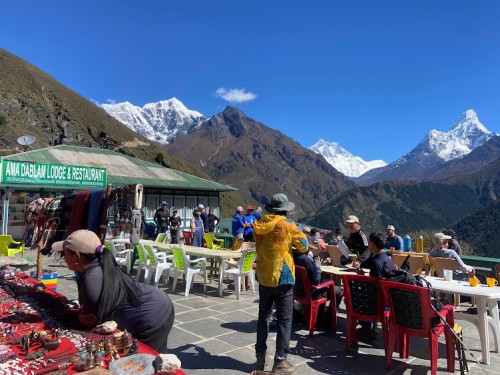
The Everest Base Camp Trek is a 14-day guided teahouse trek from Lukla to Everest Base Camp (5,364 m) and Kala Patthar (5,545 m) in Nepal's Khumbu region. Our standard itinerary includes two acclimatization days at Namche Bazaar and Dingboche, and a buffer day for Lukla flight delays.
The price is US$1,690 per person (less for groups) and includes domestic flights, permits, a licensed guide, porter support, and teahouse accommodation. Departures are private or in small groups, arranged by Nepal Himalayas Trekking, a Kathmandu-based company led by Prakash Lamsal.
| Duration | 14 days (10 days of trekking) |
| Route | Lukla – Phakding – Namche – Tengboche – Dingboche – Lobuche – Gorak Shep – EBC – Kala Patthar – Pheriche – Namche – Lukla |
| Everest Base Camp altitude | 5,364 m / 17,598 ft |
| Highest point | Kala Patthar, 5,545 m / 18,192 ft |
| Total distance | About 120–130 km round trip from Lukla |
| Difficulty | Moderate to strenuous (non-technical) |
| Accommodation | Hotel in Kathmandu, teahouse lodges on the trek |
| Best seasons | March–May and mid-September–mid-December |
| Group size | 1 person and up (private or group) |
| Guide | Government-licensed, English-speaking trekking guide |
| Price | From US$1,690 per person |
We meet you at the airport and transfer you to your hotel. In the evening, you meet your guide for the pre-trek briefing: route, altitude rules, permits, and a gear check. Anything you're missing (down jacket, sleeping bag, poles) can be rented or bought in Thamel. Go to bed early, since the Lukla flight leaves at dawn. Meals: none · Overnight: Kathmandu hotel
The flight takes about 35 minutes. In peak seasons, it may depart from Ramechhap instead (a 4–5 hour drive from Kathmandu, then a 20-minute flight). From Lukla, the trail follows the Dudh Koshi River past mani walls, chortens, and prayer flags. It is gentle and short on purpose, because you have just gained 1,200 m by plane. About 8 km, 3–4 hours · Meals: breakfast, lunch, dinner · Overnight: teahouse, Phakding
The first hard day. You cross several suspension bridges, enter Sagarmatha National Park at Monjo where permits are checked, and cross the high Hillary Suspension Bridge. Then comes a steep climb of two to three hours. On a clear day, you may get a first glimpse of Everest. Namche is the Sherpa capital, with bakeries, gear shops, and a small museum. About 10 km, 5–6 hours, +830 m · Overnight: teahouse, Namche
A rest day with a short, slow walk: up to the Everest View Hotel (3,880 m) for a first proper view of Everest, Lhotse and Ama Dablam, then on to Khumjung village and back. The rule is "climb high, sleep low". Drink three to four liters of water and spend the afternoon at the Sherpa museum or the national park visitor centre. 3–4 hours · Overnight: Namche
A mostly level trail above the valley gives you views of Ama Dablam and Thamserku. Then a long descent to the river at Phunki Thenga for lunch, followed by about 600 m of climbing through forest to Tengboche, with its monastery and Ama Dablam standing behind it. Ask your guide about the afternoon prayers. About 10 km, 5–6 hours · Overnight: Tengboche
Down through rhododendron forest to Deboche, across the Imja Khola and up through Pangboche. Above Pangboche, the trees thin out and you enter open, high country. Dingboche sits in a wide valley of stone-walled fields with Island Peak at the far end. About 11 km, 5–6 hours, +550 m · Overnight: Dingboche
The key acclimatization day. The usual option is the Nangkartshang ridge (about 5,083 m, higher than tomorrow's overnight stop). If you're not feeling strong, a shorter walk toward Chhukung (about 4,730 m) does the job. Either way, you return to sleep at 4,410 m. Views take in Makalu, Lhotse, Ama Dablam, and Island Peak. 4–5 hours · Overnight: Dingboche
A short day in distance, but above 4,500 m everything feels slower. The trail climbs to Thukla (Dughla) for lunch, then steeply up to the Chukpi Lhara memorial, where stone chortens honor climbers and Sherpas who died on Everest. From there it follows the Khumbu Glacier moraine to Lobuche. Rooms are basic and cold, and appetite drops, so eat anyway. About 8 km, 5–6 hours, +530 m · Overnight: Lobuche
Walk to Gorak Shep (about 3 hours), have lunch, then walk the rocky moraine to Base Camp (3–4 hours round trip). You'll see the Khumbu Icefall above the camp. In April and May, expedition tents fill the site, while outside the climbing season it is quiet and empty. You sleep back in Gorak Shep, the highest night of the trek. Poor sleep is normal here. About 7–8 hours in total · Overnight: Gorak Shep
Why Base Camp first? You reach Gorak Shep with the whole afternoon free, and Kala Patthar at sunrise the next morning, when the sky is usually clearest, is the highlight. Your guide may swap the order depending on weather or how the group feels.
A pre-dawn climb of 2–3 hours in the cold. The reward is Everest, Nuptse, Lhotse and Pumori glowing at sunrise, the clearest view of Everest's summit on the whole trek. Back to Gorak Shep for breakfast, then a long descent through Lobuche and Thukla to Pheriche. The air thickens, and your appetite and sleep improve as you drop. One of the longest days: roughly 8–9 hours · Overnight: Pheriche
A long descent through Pangboche and Tengboche, across the river and up to Namche. Coming back into Namche feels like a small city after the high country: bakery, hot shower, a real meal. About 19 km, 6–8 hours · Overnight: Namche
The last walking day: down to the Dudh Koshi, back over the Hillary Bridge, through Monjo and Phakding, then a steady climb into Lukla. Dinner with your guide and porters. About 18 km, 6–7 hours · Overnight: Lukla
An early flight (about 35 minutes), weather permitting, then a hot shower at your hotel and a free afternoon. This day also acts as your buffer if flights are delayed. Meals: breakfast · Overnight: Kathmandu hotel
Airport transfer for your international flight. Keep at least two free days after Day 13 in case Lukla flights are delayed, especially if you have a tight international connection.
Optional extra day: Kathmandu heritage tour (Durbar Square, Swayambhunath, Boudhanath, Pashupatinath). Ask us to add it before or after the trek.
The price per person depends on group size:
| Group size | Price per person |
|---|---|
| 1 | US$1,690 |
| 2–4 | US$1,610 |
| 5–7 | US$1,550 |
| 8–12 | US$1,510 |
| 13+ | US$1,490 |
Private departures, upgraded lodges, extra Kathmandu nights, and helicopter options change the price. Contact us for a quote.
| Place | Altitude |
|---|---|
| Kathmandu | 1,400 m |
| Lukla | 2,860 m |
| Phakding | 2,610 m |
| Namche Bazaar | 3,440 m |
| Tengboche | 3,860 m |
| Dingboche | 4,410 m |
| Lobuche | 4,940 m |
| Gorak Shep | 5,164 m |
| Everest Base Camp | 5,364 m |
| Kala Patthar | 5,545 m |
It is a moderate to strenuous high-altitude trek. It needs no climbing skills, ropes or mountaineering experience, but you should expect:
For most people, the hardest part is altitude combined with long days, not technical terrain.
Can beginners do it? Yes. First-time trekkers complete this route every season if they prepare and follow a sensible acclimatization schedule. Previous trekking experience helps but isn't required.
How to prepare: Start 8–12 weeks before departure. Build up cardio (running, cycling, swimming), do stair and hill training, and do longer weekend hikes carrying a daypack. Break in your boots before you arrive.
Altitude is the main challenge on this trek. Our itinerary builds in:
To reduce your risk: walk slowly, drink three to four liters of fluid a day, eat well even when appetite drops, avoid alcohol, and tell your guide right away about headache, nausea, dizziness or unusual breathlessness. If symptoms worsen, we stop ascending and descend. Your guide's decision on health and safety is final.
No season guarantees clear skies or on-time flights.
The trek starts with a flight to Lukla (Tenzing-Hillary Airport). Depending on season and airline operations, flights may leave from Kathmandu or from Ramechhap (Manthali), about a 4–5 hour drive away, so a very early start is normal.
Mountain weather delays or cancels flights regularly. Our itinerary includes a buffer at the end, but we recommend keeping at least two spare days before your international flight home. If your flight is cancelled, we help with rebooking and alternatives. A helicopter from Lukla or Gorak Shep can be arranged at extra cost, subject to weather and availability.
Permits: The Sagarmatha National Park entry permit and the Khumbu Pasang Lhamu Rural Municipality permit cost about US$50–60 combined, subject to change. We arrange both, and both are included in your package. [Verify current fees before publishing.]
Guide and porter: [Verify the current regulation for your nationality and route before publishing.] Every Nepal Himalayas Trekking departure includes a government-licensed guide who handles navigation, pace, acclimatization, lodging, and emergencies. A porter carries your main bag so you can walk with a light daypack, which makes a real difference at altitude.
Insurance: Your travel insurance must explicitly cover high-altitude trekking up to at least 5,500 m and emergency helicopter evacuation. Standard policies often exclude both, so check the policy wording before you buy.
Food: Meals are in teahouses. Typical choices include dal bhat, noodles, pasta, soup, potatoes, eggs, pancakes, bread, tea and coffee. Dal bhat is popular for its slow-release energy. Eat big breakfasts and drink soup for warmth at altitude.
Accommodation: Twin-sharing rooms in teahouses with blankets and a shared dining room with a stove. Bathrooms are shared at higher elevations. Hot showers, charging and Wi-Fi cost extra, and prices rise with altitude. Bring a warm sleeping bag rated to -10°C to -15°C.
Cash: Carry Nepalese rupees. Plan on roughly US$200–400 equivalent for drinks, snacks, charging, showers, Wi-Fi, and tips. ATMs exist only in Lukla and Namche and are often unreliable. There are none above Namche, and cards are rarely accepted. Exchange and withdraw cash in Kathmandu before you fly.
Tipping guideline: About US$10–15 per day for your guide and US$8–12 per day for your porter, paid in cash at the end of the trek.
Charging and Wi-Fi: Available in most teahouses for a fee, but signal drops above Namche. Bring a power bank.
Clothing: Base layers (thermal top and bottom), fleece or mid-layer, down jacket, waterproof shell jacket and pants, trekking trousers and shorts, warm hat, sun hat, gloves (thin and warm), buff, trekking socks (3–4 pairs).
Gear: Broken-in trekking boots, camp shoes, sleeping bag (-10°C to -15°C), trekking poles, 30–35 L daypack, headlamp with spare batteries, 1 L water bottles (two), water purification tablets, sunglasses (UV 400), sunscreen and lip balm.
Personal: Passport and photocopies, travel insurance papers, personal medicines and a basic first-aid kit, toiletries, power bank and adapters, cash in rupees.
Anything missing can be rented or bought in Kathmandu's Thamel district.
We are a Kathmandu-based, locally owned trekking company operating since 2012. Prakash Lamsal, our founder, has worked in Nepal's trekking industry since 2012 and has led many treks to Everest Base Camp.
I first guided the 14-day Everest Base Camp trek in 2012 with a group of German clients, using Namche Bazaar and Dingboche as our acclimatization stops. On rest days, we didn't sit still: we hiked to the Sagarmatha National Park area, Syangboche airstrip, and Kumjung village, and took a similar hike above Dingboche. The views from Namche all the way up to Dingboche made it an unforgettable trip, and one I still remember well.
5.0 rating from [50] verified reviews on this trip · read more reviews on TripAdvisor
"Prakash personally checked in with us before and after the trek, which made the experience feel very personal." — Michael Thompson, United States, February 2026
"Our guide carefully managed acclimatization in Namche Bazaar, which made the Everest Base Camp Trek comfortable even at high altitude." — Daniel, Italy, March 2026
How many days is the Everest Base Camp Trek? Our standard trek takes 14 days, including arrival and departure in Kathmandu, two acclimatization days, and a buffer for the Lukla flight. Shorter and helicopter-return options are available.
How high is Everest Base Camp? About 5,364 m (17,598 ft) on the Nepal (south) side. The highest point on our route is Kala Patthar at 5,545 m.
Is Everest visible from Base Camp? Only partly, because ridges block the summit. Kala Patthar gives the clearest view of Everest.
How much does the trek cost? From US$1,690 per person for one traveler, and less for groups (US$1,490 for 13+). The price includes flights, permits, a guide, a porter, and teahouses. See the cost section for details.
How difficult is it? Can beginners do it? It is moderate to strenuous. Beginners can do it with 8–12 weeks of training, a gradual acclimatization schedule, and a good guide.
Do I need a guide or a porter? A licensed guide is part of every package. [Verify the current rule before publishing.] A porter isn't compulsory, but most trekkers prefer one because it makes the days much easier.
What permits do I need? The Sagarmatha National Park permit and the Khumbu Pasang Lhamu Rural Municipality permit. We arrange both.
What is the best time to go? March–May and mid-September–mid-December have the most stable weather and clearest views.
What happens if my Lukla flight is cancelled? Flights are often delayed by weather. We help with rescheduling or a helicopter at an extra cost. Keep at least two spare days before your international flight.
What if I get altitude sickness? Tell your guide immediately. Depending on severity, we rest, stop ascending, descend, or arrange emergency helicopter evacuation. Make sure your insurance covers this.
Where do we sleep and what do we eat? Twin-sharing teahouse lodges along the route. Meals include dal bhat, noodles, pasta, soup, eggs, and more, and full-board meals are included in the price during the trek.
How much cash should I carry? Around US$200–400 equivalent in rupees for personal expenses. There are no ATMs above Namche.
Can I charge devices and get Wi-Fi? Yes, in most teahouses for a fee, but the signal is weak above Namche. Carry a power bank.
Do I need travel insurance? Yes. It must cover high-altitude trekking above 5,000 m and emergency helicopter evacuation.
Can I return by helicopter? Yes. A helicopter return from Gorak Shep or Lukla can be arranged as an optional extra, subject to weather and availability.
Ready to walk to the base of Mount Everest? Tell us your preferred dates and group size, and our Kathmandu team will plan your trek.
Everest Base Camp Trek – from US$1,690 per person
[Book this trek] [Ask a question] [Customize this itinerary]
WhatsApp / Viber: +977 9841044334 Email: info@nepalhimalayastrekking.com Nepal Himalayas Trekking Pvt. Ltd., Amrit Marg, Thamel, Kathmandu, Nepal
We meet you at the airport and take you to your hotel in Kathmandu. In the evening, you meet your guide for the pre-trek briefing: route, altitude rules, permits and a gear check. Anything you're missing (down jacket, sleeping bag, poles) can be rented in Thamel. Go to bed early, since the Lukla flight leaves at dawn. Meals: none. Overnight: Kathmandu hotel.
The flight takes about 35 minutes. In spring and autumn, it may leave from Ramechhap instead (a 4- to 5-hour drive from Kathmandu, then a 20-minute flight). From Lukla, the trail follows the Dudh Koshi river past mani walls, chortens, and prayer flags. It is mostly gentle and slightly downhill, and short on purpose: you have just gained 1,200 m by plane. About 8 km, 3 to 4 hours. Meals: breakfast, lunch, dinner. Overnight: teahouse, Phakding.
The first hard day. You cross several suspension bridges, enter Sagarmatha National Park at Monjo, where permits are checked, and cross the high Hillary Suspension Bridge. Then comes a steep climb of two to three hours. On a clear day you may get a first glimpse of Everest on the way up. Namche is the Sherpa capital, with bakeries, gear shops and a small museum. About 10 km, 5 to 6 hours, +830 m. Overnight: teahouse, Namche.
A rest day with a short, slow walk: up to the Everest View Hotel (3,880 m) for a first proper view of Everest, Lhotse and Ama Dablam, then on to Khumjung village and back. Climb high, sleep low. Drink three to four liters of water. Spend the afternoon at the Sherpa museum or the national park visitor centre. 3 to 4 hours. Overnight: Namche.
A mostly level trail above the valley gives you views of Ama Dablam and Thamserku. Then a long descent to the river at Phunki Thenga for lunch, followed by about 600 m of climbing through forest to Tengboche, the largest monastery in the Khumbu, with Ama Dablam standing behind it. Ask your guide about the afternoon prayers. About 10 km, 5 to 6 hours. Overnight: Tengboche.
Down through rhododendron forest to Deboche, across the Imja Khola, and up thro