
Any Question? Email Us
info@nepalhimalayastrekking.comTalk To An Expert ( Prakash Lamsal )
Any Question? Email Us
info@nepalhimalayastrekking.comTalk To An Expert ( Prakash Lamsal )
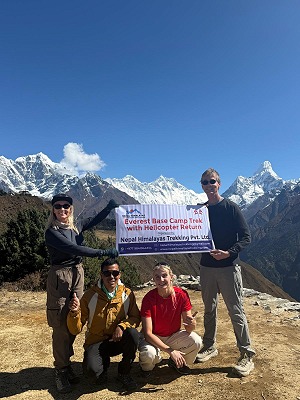
The Everest Base Camp Trek is a 14-day guided teahouse trek from Lukla to Everest Base Camp (5,364 m) and Kala Patthar (5,545 m) in Nepal's Khumbu region. It needs no climbing skills. Most fit beginners finish it with two acclimatization days, a steady pace and a good guide.
With Nepal Himalayas Trekking, the trek costs US$1,690 per person for a solo traveler and drops to US$1,490 for groups of 13 or more. The price covers Lukla flights, permits, a government-licensed guide, a porter, teahouse rooms and three meals a day on the trail.
You walk through Sagarmatha National Park, a UNESCO World Heritage Site. You sleep in Sherpa villages, cross the Hillary Suspension Bridge, visit Tengboche Monastery and watch sunrise light up Everest from Kala Patthar.
Detail | Everest Base Camp Trek |
|---|---|
Duration | 14 days (11 walking days) |
Start/end | Kathmandu |
Trek start | Lukla (2,860 m), by flight from Kathmandu or Ramechhap |
Everest Base Camp | 5,364 m / 17,598 ft |
Highest point | Kala Patthar, 5,545 m / 18,192 ft |
Highest night | Gorak Shep, 5,164 m |
Distance | About 120–130 km return from Lukla |
Walking per day | 5–8 hours on most days |
Difficulty | Moderate to strenuous, non-technical |
Acclimatization | Namche Bazaar (Day 4) and Dingboche (Day 7) |
Accommodation | Hotel in Kathmandu, twin-sharing Standard teahouses on the trek |
Best seasons | March–May and mid-September–mid-December |
Group size | From 1 person, private or small group |
Price | From US$1,690 per person (US$1,490 for 13+) |
The 14-day itinerary climbs from Lukla to Base Camp in eight days, with rest days at Namche and Dingboche, and returns by the same trail. The sleeping altitude never rises more than about 550–830 m in a day above 3,000 m.
Day | Route | Sleep altitude | Walking |
|---|---|---|---|
1 | Arrive in Kathmandu, trek briefing and gear check | 1,400 m | — |
2 | Fly to Lukla, trek to Phakding | 2,610 m | 3–4 hrs |
3 | Phakding to Namche Bazaar via Hillary Bridge | 3,440 m | 5–6 hrs |
4 | Acclimatization in Namche: Everest View Hotel and Khumjung | 3,440 m | 3–4 hrs |
5 | Namche to Tengboche Monastery | 3,860 m | 5–6 hrs |
6 | Tengboche to Dingboche | 4,410 m | 5–6 hrs |
7 | Acclimatization in Dingboche: Nangkartshang ridge (5,083 m) | 4,410 m | 4–5 hrs |
8 | Dingboche to Lobuche via the climbers' memorial | 4,940 m | 5–6 hrs |
9 | Lobuche to Gorak Shep, then Everest Base Camp | 5,164 m | 7–8 hrs |
10 | Kala Patthar at sunrise, descend to Pheriche | 4,240 m | 8–9 hrs |
11 | Pheriche to Namche Bazaar | 3,440 m | 6–8 hrs |
12 | Namche to Lukla, farewell dinner with the crew | 2,860 m | 6–7 hrs |
13 | Fly Lukla to Kathmandu (buffer for flight delays) | 1,400 m | — |
14 | Final departure | — | — |
Why Base Camp before Kala Patthar? You reach Gorak Shep with the afternoon free for Base Camp. Kala Patthar then gets the clear, still air of the next sunrise. Your guide may swap the order for weather.
Short on time? See the Everest Base Camp Trek 12 Days or the Everest Base Camp Trek with Helicopter Return.
The 14-day Everest Base Camp Trek costs US$1,690 per person for one traveler and less per person as your group grows. There are no hidden fees: flights, permits, guide, porter, rooms and trail meals are in the price.
Group size | Price per person |
|---|---|
1 person | US$1,690 |
2–4 people | US$1,610 |
5–7 people | US$1,550 |
8–12 people | US$1,510 |
13+ people | US$1,490 |
Package | Price per person | Best for |
|---|---|---|
From US$1,300 | Lowest cost, simpler services | |
US$1,490 | Avoiding the Lukla flight | |
US$1,790 | Extra focus on the Kala Patthar sunrise | |
Private EBC Trek | US$1,890–3,090 | Your own dates, guide and pace |
US$4,890–6,500+ | Best lodges and attached bathrooms |
Helicopter add-ons: fly back to Lukla after Base Camp for US$2,390 (sharing) or US$3,290 (private). Fly from Lukla to Kathmandu for US$2,990 (sharing) or US$4,890 (private). See the Gorak Shep to Lukla Helicopter.
For a full breakdown, read our Everest Base Camp Trek Cost guide.
The best time for the Everest Base Camp Trek is spring (March–May) and autumn (mid-September–mid-December). Both seasons bring stable weather, dry trails and the most reliable Lukla flights. Autumn has the clearest views; spring is warmer, with rhododendrons in bloom and climbing teams at Base Camp.
Season | Months | Weather and views | Crowds | Flight delays |
|---|---|---|---|---|
Autumn | Mid-Sep to mid-Dec | Clearest skies, best mountain views | Highest | Low to moderate |
Spring | March to May | Warmer, stable, some afternoon haze | High | Low to moderate |
Winter | Mid-Dec to February | Crisp and clear, very cold nights | Low | Moderate |
Monsoon | June to August | Rain, cloud, green valleys | Lowest | Highest |
Winter and monsoon treks still run. We operate them for trekkers who want quiet trails and can accept cold nights or hidden views. Our next fixed departures are in late October, early November 2026 and January 2027.
The Everest Base Camp Trek is moderate to strenuous, and the hard part is altitude, not the trail. You need no ropes or climbing skills. You do need the stamina to walk 5–8 hours a day on rocky, uneven paths for 11 days.
What to expect:
Can beginners do it? Yes. First-time trekkers reach Base Camp every season. Prior trekking helps but is not required.
Start 8–12 weeks before your trip:
Our itinerary follows a slow climb with two rest days, at Namche (3,440 m) and Dingboche (4,410 m). Each rest day includes a short hike higher before sleeping lower.
On the trail, walk slowly, drink 3–4 liters of fluid a day, eat even when your appetite drops and skip alcohol. Tell your guide at once about headache, nausea, dizziness or unusual breathlessness. Our guides check oxygen levels daily. If symptoms worsen, we stop climbing and descend. The guide's call on safety is final.
You need two permits for the Everest Base Camp Trek, and both are included in our price.
Permit | Foreigners | SAARC nationals | Where it is issued |
|---|---|---|---|
Sagarmatha National Park Entry Permit | NPR 3,000 + 13% VAT | NPR 1,500 + 13% VAT | Monjo gate or Nepal Tourism Board, Kathmandu |
Khumbu Pasang Lhamu Rural Municipality Permit | NPR 3,000 | NPR 3,000 | Lukla (not available in Kathmandu) |
The municipality fee rose from NPR 2,000 to NPR 3,000 in 2026. Together the two permits cost about US$45–50. Fees can change, so we confirm them before your trek. Every Nepal Himalayas Trekking departure includes a government-licensed guide.
The trek starts with a 25–35 minute flight to Lukla. In peak months, Nepal's Civil Aviation Authority moves most Lukla flights to Manthali Airport in Ramechhap to ease traffic in Kathmandu. That means an early 4–5 hour drive before a 20-minute flight. Our team arranges the transfer and, if needed, an overnight in Ramechhap.
Mountain weather delays flights. Day 13 is your buffer, and we advise one or two more spare days before your international flight. If flights stop, we rebook you or arrange a helicopter at extra cost. Read our Kathmandu to Lukla Flight guide.
You stay in family-run teahouses in twin-sharing rooms with beds, blankets and a warm dining room. Bathrooms are shared higher up. Hot showers, charging and Wi-Fi cost extra, and prices rise with altitude.
Meals include dal bhat, noodles, pasta, soups, potatoes, eggs, pancakes, tea and coffee. Dal bhat comes with free refills and is the best fuel for long days.
Nepal Himalayas Trekking is a locally owned Kathmandu company, run by founder Prakash Lamsal, that has guided Everest Base Camp treks since 2012. The trek holds a 5.0 rating from 50 traveler reviews, and the company has 225 verified reviews across all trips.
"Prakash personally checked in with us before and after the trek, which made the experience feel very personal." — Michael Thompson, United States, February 2026
Tell us your dates and group size, and our Thamel team will plan your trek. Upcoming fixed departures start on 25 Oct, 29 Oct, 31 Oct, 2 Nov and 5 Nov 2026, and 3 and 5 Jan 2027.
Everest Base Camp Trek: from US$1,690 per person
Book this trip · Ask a question · Customize this itinerary
WhatsApp / Viber: +977 9841044334 · Email: info@nepalhimalayastrekking.com · Amrit Marg, Thamel, Kathmandu
How many days is the Everest Base Camp Trek? Our standard trek is 14 days from Kathmandu, with 11 walking days. A 12-day version and helicopter-return options are also available.
How much does the Everest Base Camp Trek cost? US$1,690 per person for one traveler, falling to US$1,490 for groups of 13 or more. Flights, permits, guide, porter, rooms and trail meals are included.
How high is Everest Base Camp? Everest Base Camp sits at 5,364 m (17,598 ft). The trek's highest point is Kala Patthar at 5,545 m.
Can you see Everest from Base Camp? Only partly, because ridges hide the summit. Kala Patthar gives the clearest view of Everest on the trek.
Is the Everest Base Camp Trek hard for beginners? It is moderate to strenuous but non-technical. Beginners succeed with 8–12 weeks of training and a well-paced itinerary.
When is the best time to trek to Everest Base Camp? March to May and mid-September to mid-December. Autumn has the clearest skies; spring is warmer with rhododendrons in bloom.
What permits do I need? The Sagarmatha National Park Entry Permit and the Khumbu Pasang Lhamu Rural Municipality Permit. We arrange both.
Do I need a guide? Every Nepal Himalayas Trekking package includes a licensed guide. A guide handles pace, altitude checks, rooms and emergencies.
Where do flights to Lukla leave from? From Kathmandu off-season and from Ramechhap (Manthali) in peak spring and autumn months. We arrange the transfer.
What if my Lukla flight is cancelled? We rebook you on the next flight or arrange a helicopter at extra cost. Keep one or two spare days before flying home.
What happens if I get altitude sickness? Tell your guide right away. We rest, stop climbing or descend, and arrange a helicopter evacuation if needed.
Do I need supplemental oxygen? No. Good acclimatization is enough for trekkers at Base Camp.
Can I sleep at Everest Base Camp? Trekkers sleep at Gorak Shep (5,164 m) and visit Base Camp on a day walk. Only expedition climbers camp there.
How much cash should I carry? About US$200–400 in Nepalese rupees. ATMs and card machines are unreliable, and there are none above Namche.
Can I retur