

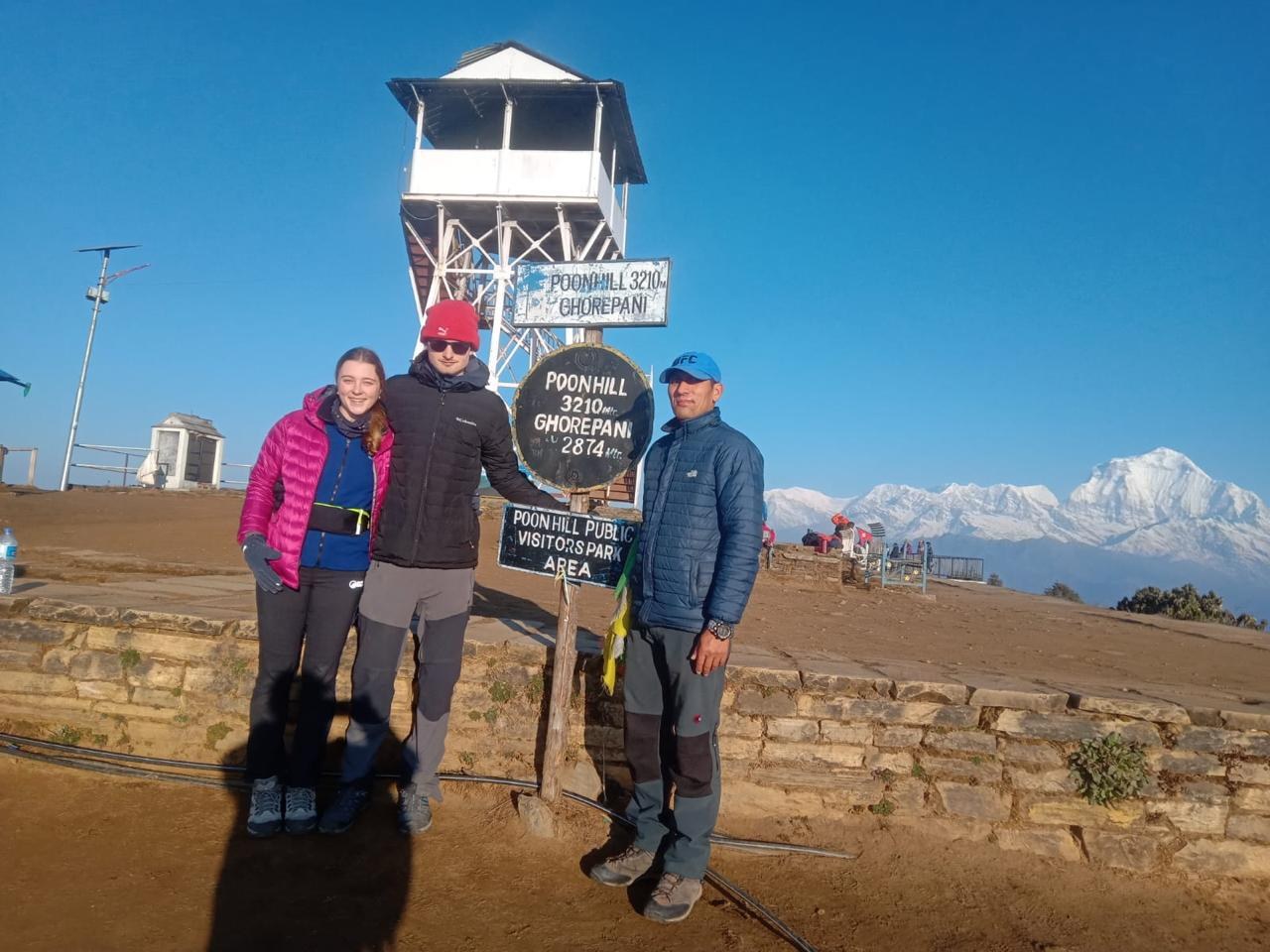
The Ghorepani Poon Hill Trek is a scenic trekking journey in Nepal's Annapurna region, known for its Himalayan sunrise, traditional Gurung and Magar villages, and rhododendron forests. The route passes through Nayapul, Ulleri, Ghorepani, Tadapani and Ghandruk, combining mountain scenery with opportunities to experience village life in the Annapurna foothills. It is a popular choice for travellers who want to explore the Himalayas without committing to a long, high-altitude expedition.
The highest point is Poon Hill at 3,210 metres (10,531 feet). From this viewpoint, you can see a wide panorama of the Annapurna and Dhaulagiri ranges, including Annapurna I, Dhaulagiri, Machhapuchhre (Fishtail) and Nilgiri. The early morning walk from Ghorepani to Poon Hill is the main highlight. You reach the viewpoint before sunrise and watch the first light spread across the surrounding snow-covered peaks.
Our 10-day Ghorepani Poon Hill Trek package starts in Kathmandu and includes Kathmandu Valley sightseeing, travel to Pokhara, the trekking journey and your return to Kathmandu. The walking route covers approximately 32–40 km, depending on the starting point and trail followed. Along the way, you climb the stone steps towards Ulleri, walk through oak and rhododendron forests, visit traditional mountain settlements and spend time in the Annapurna foothills. The package includes a licensed local guide, trekking staff, accommodation, meals during the trek, ACAP and TIMS arrangements.
Quick Facts: Ghorepani Poon Hill Trek
| Trek detail | Information |
|---|---|
| Duration | 10 days |
| Destination | Ghorepani and Poon Hill, Annapurna region |
| Starting point | Kathmandu |
| Trekking starting point | Nayapul |
| Main route | Nayapul – Ulleri – Ghorepani – Poon Hill – Tadapani – Ghandruk – Nayapul |
| Highest point | Poon Hill, 3,210 m |
| Ghorepani elevation | Approximately 2,874 m |
| Trekking distance | Approximately 32–40 km |
| Daily walking time | Generally 3–6 hours |
| Trek difficulty | Easy to moderate |
| Best seasons | Spring and autumn |
| Accommodation | Hotels in Kathmandu and Pokhara; mountain teahouses |
| Permits | ACAP and TIMS |
| Guide | Licensed English-speaking local guide |
| Package price | USD 574–690 per person, depending on group size |
What Is the Ghorepani Poon Hill Trek?
The Ghorepani Poon Hill Trek is a short Himalayan route in the Annapurna Conservation Area of north-central Nepal. It is especially known for its sunrise viewpoint, accessible mountain trails and traditional settlements. Unlike longer Himalayan journeys that cross high mountain passes or reach elevations above 5,000 metres, this route reaches a maximum elevation of 3,210 metres at Poon Hill. This makes it a popular introduction to trekking in Nepal, although the uphill sections still require reasonable fitness. If you are comparing different destinations, explore our guide to the best trekking routes in Nepal for more ideas.
The walking route begins at Nayapul, reached by road from Pokhara. From there, the trail follows the Modi Khola valley and climbs through settlements and forested hillsides towards Ulleri and Ghorepani. After the early morning visit to Poon Hill, you return to Ghorepani and continue towards Tadapani and Ghandruk. The journey finishes with a descent to Nayapul and a drive back to Pokhara. Ghandruk, a well-known Gurung village, is a particularly interesting stop for its traditional houses, local culture and views of the Annapurna range.
Why Choose the Ghorepani Poon Hill Trek?
The main attraction of the Ghorepani Poon Hill Trek is the variety of experiences it offers within a relatively short walking route. You can enjoy a Himalayan sunrise, walk through rhododendron forests, visit traditional villages and see the Annapurna and Dhaulagiri ranges without undertaking a demanding high-altitude expedition. The route also allows time to experience Pokhara and Kathmandu as part of a longer holiday in Nepal. Here are some of the experiences that make this trek worth considering.
Watch Sunrise from Poon Hill
Poon Hill is the main viewpoint of the trek. At 3,210 metres, it provides a broad panorama of the Annapurna and Dhaulagiri ranges. The early morning climb from Ghorepani takes approximately one hour, depending on your pace and trail conditions. Reaching the viewpoint before sunrise gives you time to find a place to watch the changing colours across the mountains. On a clear morning, you can see Annapurna I, Dhaulagiri, Machhapuchhre, Nilgiri and other surrounding peaks.
Visit Traditional Gurung and Magar Villages
The trail passes through settlements associated with the Gurung and Magar communities, whose cultures are an important part of the Annapurna region. Ulleri is a traditional Magar village, while Ghandruk is particularly well known for its Gurung heritage. In Ghandruk, you can walk through traditional stone houses, visit the local museum and handicraft centre, and learn more about village life. The village also offers views of Annapurna South, Hiunchuli and Machhapuchhre from its surrounding hillsides.
Walk Through Rhododendron and Oak Forests
Between Ulleri and Ghorepani, the trail passes through sections of oak and rhododendron forest. Spring is especially attractive, as rhododendrons bloom across the hillsides, adding colour to the walking route. The forest sections provide a different experience from the open mountain viewpoints and terraced farmland near the villages. During autumn, the trail is also enjoyable, with generally favourable walking conditions and clearer weather than during the monsoon.
Experience the Annapurna Region Without a Long Expedition
The Poon Hill route offers a Himalayan trekking experience without requiring several weeks on the trail. Its highest point is 3,210 metres, considerably lower than destinations such as Everest Base Camp or the Thorong La Pass on the Annapurna Circuit. You still experience mountain villages, forest trails and views of major Himalayan peaks, but the walking section is relatively short. Our 10-day package also includes time in Kathmandu and Pokhara, making it suitable for travellers who want to combine trekking with cultural sightseeing.
Climb the Ulleri Stone Staircase
The ascent towards Ulleri is one of the most recognisable sections of the route. From the lower settlements, the trail climbs a long stone staircase towards the village, gaining elevation steadily. This section can be tiring, particularly for first-time trekkers, but there is no need to rush. Take breaks when necessary and keep a steady pace. As you climb, the views of the surrounding hills and valley gradually open up.
Enjoy Mountain Scenery Beyond Poon Hill
Poon Hill provides the main sunrise panorama, but the mountain views are not limited to that viewpoint. You can see parts of the Annapurna range from different sections of the route, particularly around Ulleri and Ghandruk. The scenery changes as you move between forested paths, open hillsides and traditional settlements. Around Ghandruk, the views of Annapurna South, Hiunchuli and Machhapuchhre provide another memorable part of the journey.
Experience Local Teahouse Hospitality
During the walking section, you stay in local mountain lodges and teahouses in villages such as Ulleri, Ghorepani, Tadapani and Ghandruk. These accommodations are generally simple, with basic rooms and shared facilities in many places. Meals commonly include dal bhat, noodles, rice, soup, potatoes and eggs. Staying in local teahouses gives you the opportunity to experience mountain hospitality and spend time in the settlements along the route.
Choose a Beginner-Friendly Himalayan Route
The Ghorepani Poon Hill Trek is generally graded easy to moderate compared with many longer Himalayan journeys. It does not require technical climbing skills or mountaineering experience. However, you should be prepared for uphill walking, stone steps and uneven mountain paths. With reasonable fitness, suitable footwear and a comfortable walking pace, beginners can enjoy the route. Previous trekking experience is helpful but not essential.
Combine Trekking with Kathmandu and Pokhara
Our 10-day itinerary includes more than the mountain walk. Before reaching the Annapurna foothills, you have time to visit cultural and religious landmarks in the Kathmandu Valley. You then travel to Pokhara, a lakeside city beneath the Annapurna range, before starting the trek from Nayapul. This combination gives you an opportunity to experience Nepal's cultural heritage, city life and mountain landscapes within one holiday.
Explore the Annapurna Foothills at a Comfortable Pace
The Poon Hill area can be explored through different short itineraries, depending on your available time and preferred walking route. Some travellers choose a shorter journey, while others continue towards Tadapani and Ghandruk to experience more of the Annapurna foothills. Our listed package follows the 10-day programme from Kathmandu, including the route through Ulleri, Ghorepani, Poon Hill, Tadapani and Ghandruk. If you prefer a private arrangement or have different travel dates, speak with our team before booking.
Ghorepani Poon Hill Trek Route and Distance
The Ghorepani Poon Hill Trek covers approximately 32–40 km of walking, depending on the starting point and route followed. The trail begins near Nayapul at approximately 1,070 metres and climbs towards Ulleri at around 1,960 metres. You then continue through forested hillsides to Ghorepani, which sits at approximately 2,874 metres. The early morning hike to Poon Hill takes you to 3,210 metres, the highest point of the journey.
The main route follows:
Kathmandu → Pokhara → Nayapul → Ulleri → Ghorepani → Poon Hill → Tadapani → Ghandruk → Nayapul → Pokhara → Kathmandu.
After visiting Poon Hill, you return to Ghorepani and continue towards Tadapani and Ghandruk. The route includes forest trails, stone steps, village paths and downhill sections before reaching Nayapul. The Ulleri ascent is one of the more demanding parts because of its long staircase, while the descent towards Ghandruk and Nayapul requires care on uneven ground. Daily walking time is generally around 3–6 hours, depending on the day, pace and trail conditions.
How Are the Days Like During the Ghorepani Poon Hill Trek?
The walking days on the Ghorepani Poon Hill Trek vary in character. The first trekking day involves travelling from Pokhara to Nayapul before climbing towards Ulleri. The following day is mainly an uphill walk through forest towards Ghorepani. You then have an early start for the Poon Hill sunrise before continuing to Tadapani. The walk from Tadapani to Ghandruk is generally shorter, giving you more time to explore the village after arrival.
The final trekking day takes you downhill from Ghandruk to Nayapul, where your vehicle takes you back to Pokhara. The route is not equally demanding every day: the stone staircase towards Ulleri and the climb to Ghorepani require more effort, while the Ghandruk section is shorter. Our guide helps you maintain a suitable pace, choose appropriate rest stops and understand the trail conditions each day.
Our 10-Day Ghorepani Poon Hill Trek Itinerary
Our 10-day itinerary begins in Kathmandu and follows the trekking route through the Annapurna foothills. It includes Kathmandu Valley sightseeing, travel to Pokhara, five days of trekking and the return journey to Kathmandu. The itinerary is designed to combine cultural visits with the mountain journey while keeping the walking section focused on Ulleri, Ghorepani, Poon Hill, Tadapani and Ghandruk.
Trekking route: Kathmandu → Pokhara → Nayapul → Ulleri → Ghorepani → Poon Hill → Tadapani → Ghandruk → Nayapul → Pokhara → Kathmandu.
Day 1: Arrival in Kathmandu
After arriving at Tribhuvan International Airport, our representative welcomes you and arranges your private transfer to the hotel. You can rest after your journey and prepare for the trek. Our team will brief you about the itinerary and the arrangements for the coming days.
Day 2: Kathmandu Valley Sightseeing
Today, you explore important cultural and religious sites in the Kathmandu Valley with a local tour guide. The sightseeing programme includes Pashupatinath Temple, Swayambhunath, Boudhanath, Kathmandu Durbar Square and Patan Durbar Square. These landmarks offer an introduction to Nepal's history, architecture and religious traditions before you travel towards the Annapurna region.
Day 3: Travel from Kathmandu to Pokhara by Road or Air
Travel from Kathmandu to Pokhara by tourist bus or domestic flight. By road, the journey takes around 6–7 hours, depending on traffic, road conditions and weather, while by air, the flight takes approximately 30 minutes. The road follows the Prithvi Highway through river valleys and roadside settlements, so keep water, snacks and any motion sickness medication handy. Flights are quicker but may face weather delays. If you take an early morning flight, you can arrive in Pokhara in time for a half-day sightseeing tour, a walk around Lakeside and last-minute trekking preparations.
Day 4: Pokhara to Nayapul and Trek to Ulleri (1,960 m)
Leave Pokhara and travel by vehicle towards Nayapul, the starting point of the trek. From there, follow the Modi Khola valley through villages, terraced fields and forested sections. The trail gradually climbs towards Ulleri, a traditional Magar village known for its long stone staircase. The ascent is demanding in places, so take breaks when needed and enjoy the changing views of the surrounding hills.
Overnight: Teahouse in Ulleri.
Day 5: Ulleri to Ghorepani (2,874 m)
Continue uphill from Ulleri through oak and rhododendron forests. The trail includes stone steps, forest paths and gradual climbs as you make your way towards Ghorepani. As you gain elevation, the surroundings become more open, with occasional views of the Annapurna range. After reaching Ghorepani, settle into your teahouse and prepare for the early morning hike to Poon Hill.
Overnight: Teahouse in Ghorepani.
Day 6: Ghorepani to Poon Hill (3,210 m) and Trek to Tadapani
Start early in the morning and hike from Ghorepani to Poon Hill. The ascent generally takes around one hour, depending on your walking pace and trail conditions. From the viewpoint, enjoy the sunrise over the Annapurna and Dhaulagiri ranges. After spending time at Poon Hill, return to Ghorepani for breakfast before continuing towards Tadapani through forested sections and mountain trails.
Overnight: Teahouse in Tadapani.
Day 7: Tadapani to Ghandruk
Today, descend through forest towards Ghandruk, a well-known Gurung village in the Annapurna region. The walk generally takes around three hours, depending on your pace and trail conditions. After arriving, you can explore the village, see its traditional houses and visit the local museum and handicraft centre. The surrounding area offers views of Annapurna South, Hiunchuli, Gangapurna, Annapurna III and Machhapuchhre.
Overnight: Teahouse in Ghandruk.
Day 8: Ghandruk to Nayapul and Drive to Pokhara
After breakfast, begin the descent from Ghandruk towards Nayapul. The walk takes approximately three hours, depending on the route and your pace. At Nayapul, meet your vehicle and travel back to Pokhara. After arriving, you can rest at the hotel and enjoy the lakeside surroundings following the completion of the trekking section.
Day 9: Pokhara to Kathmandu
After breakfast, travel from Pokhara to Kathmandu by tourist bus. The road journey generally takes around 6–7 hours, although traffic and road conditions can affect the travel time. On arrival, transfer to your hotel and enjoy your final evening in the city.
Day 10: Airport Transfer and Final Departure
Your Ghorepani Poon Hill Trek comes to an end today. We arrange your private transfer to Tribhuvan International Airport according to your international flight schedule. You leave Nepal with memories of the Himalayan sunrise, traditional mountain villages and your journey through the Annapurna region.
How Difficult Is the Ghorepani Poon Hill Trek?
The Ghorepani Poon Hill Trek is generally graded easy to moderate. It is suitable for beginners and travellers with reasonable fitness, although some sections require more effort than others. The main physical challenge is the sustained uphill climb towards Ulleri and Ghorepani, followed by the early morning ascent to Poon Hill. You should be comfortable walking for several hours on uneven mountain paths and managing both uphill and downhill sections.
You do not need technical climbing skills or mountaineering experience for this trek. However, the stone staircase towards Ulleri can feel demanding if you are not used to climbing steps, and downhill trails can put pressure on your knees. Preparing with regular walking and stair climbing will help you enjoy the route. A steady pace, suitable footwear and regular breaks are more useful than trying to walk quickly.
Physical Preparation
We recommend preparing with regular walks, stair climbing and light cardiovascular exercise before travelling to Nepal. Practising uphill walks can help you become more comfortable with the long staircase towards Ulleri and the ascent to Ghorepani. Bring comfortable trekking boots with good grip, as some sections can become slippery after rain, particularly around forest paths and stone steps. You do not need an intensive mountaineering training programme, but building your walking fitness beforehand will make the journey more enjoyable.
Altitude and Acclimatization
The highest point of the trek is Poon Hill at 3,210 metres. This is lower than many high-altitude Himalayan destinations, but some travellers may still experience altitude-related symptoms, especially if they ascend quickly or are not accustomed to walking at elevation. Take time to adjust as you gain height, drink enough water and avoid rushing uphill. If you experience a persistent headache, nausea, dizziness or unusual tiredness, inform your guide. If symptoms worsen, stop ascending and seek appropriate assistance.
Best Time for Ghorepani Poon Hill Trek
Spring and autumn are the main trekking seasons for the Ghorepani Poon Hill Trek. These periods generally offer comfortable walking conditions and good opportunities to enjoy mountain views. Spring is particularly popular for rhododendron blooms, while autumn is known for generally stable weather after the monsoon. The route can also be visited during winter and monsoon, but weather and trail conditions need more consideration.
The best time for your trek depends on the experience you want. You can also read our guide to the best months for trekking in Nepal to compare seasonal conditions across different trekking regions. If seeing flowering rhododendron forests is a priority, spring is a good choice. If you prefer clearer post-monsoon conditions, consider autumn. Winter offers a quieter trail but colder mornings, while monsoon brings rain, cloud and slippery paths. We recommend checking the forecast and current trail conditions before departure, whichever season you choose.
Spring: March to May
Spring is one of the most attractive seasons for this trek because rhododendrons bloom along sections of the trail between Ulleri and Ghorepani. March and April are particularly popular for colourful hillsides. Daytime temperatures are generally comfortable for walking, although mornings and evenings can still be cold at higher elevations. Clear periods can provide good mountain views from Poon Hill and other open sections of the route.
Autumn: September to November
Autumn is another excellent season for the Ghorepani Poon Hill Trek. The monsoon rain usually clears the atmosphere, and the weather is generally more stable. October and November are particularly popular months for trekking in the Annapurna region. The conditions often provide good visibility from Poon Hill, although cloud and weather can never be ruled out. As this is a busy trekking season, booking accommodation and transport in advance is advisable.
Winter: December to February
Winter brings colder mornings and evenings, particularly around Ghorepani and Poon Hill. Snowfall may affect higher sections of the trail, depending on the weather. The trek can still be possible during winter, but you should carry warm clothing, suitable footwear and additional layers for the early morning viewpoint hike. Check the latest weather and trail conditions before departure.
Monsoon: June to August
The monsoon season brings frequent rainfall, cloudy skies and slippery trails. Leeches may also be present in forested sections, particularly after rain. Mountain views can be limited by clouds, although the landscape becomes green and lush. If you plan to trek during this period, carry waterproof clothing, a rain cover for your backpack and footwear with good grip. Allow some flexibility in your schedule in case weather affects travel.
Ghorepani Poon Hill Trek Permits and Costs
The Ghorepani Poon Hill Trek passes through the Annapurna Conservation Area, so trekkers need an Annapurna Conservation Area Permit (ACAP). Trekkers on applicable routes also require a TIMS card under the current trekking arrangements. Our package includes both ACAP and TIMS, so these required permit arrangements are covered in the listed package cost. Our team can confirm the applicable requirements for your nationality before departure. The commonly applicable permit fees are shown below. Regulations and fees can change, so we confirm the current requirements when arranging your trek.
| Nationality | ACAP fee |
|---|---|
| Foreign nationals | NPR 3,000 |
| SAARC nationals | NPR 1,000 |
| Nepali citizens | NPR 100 |
| TIMS category | Commonly listed fee |
|---|---|
| Non-SAARC foreign nationals | NPR 2,000 |
| SAARC nationals | NPR 1,000 |
What Our Guide Wants You to Know About the Route
Our local guides know the walking route between Nayapul, Ulleri, Ghorepani, Tadapani and Ghandruk. One useful point is not to underestimate the climb towards Ulleri simply because the trek is classed as easy to moderate. The stone steps take time, and a steady pace is more comfortable than trying to finish the climb quickly. Around Ghorepani, prepare your warm clothing and headlamp the night before the Poon Hill sunrise walk. Your guide can help with the early start, suitable walking pace and local trail conditions.
Ghorepani Poon Hill Trek Cost for 2026/2027
The cost of the Ghorepani Poon Hill Trek depends on the number of people travelling together. Our regular service package offers different per-person prices according to group size. The listed price covers the main arrangements for the 10-day programme, including accommodation, trekking meals, guide and porter services, transport and the required permits.
| Group size | Price per person |
|---|---|
| 1 person | USD 690 |
| 2–5 people | USD 675 |
| 6–10 people | USD 641 |
| 11–15 people | USD 608 |
| 16–25 people | USD 574 |
The package includes airport pickups and drops by private vehicle, hotel accommodation in Kathmandu and Pokhara on a bed-and-breakfast basis, mountain accommodation, meals during the trekking section, a licensed English-speaking guide, required local staff and porters, ACAP and TIMS, and the listed sightseeing and transport arrangements. International airfare, travel insurance, Nepal visa fees, personal trekking equipment, tips and personal drinks are not included. Lunch and dinner in Kathmandu and Pokhara are also excluded, except for meals specifically listed in your confirmed arrangement. For full package details, visit our Ghorepani Poon Hill Trek package.
What's Included in Our Ghorepani Poon Hill Trek Package?
The listed inclusions are:
- Airport pickups and drops by private vehicle.
- Hotel accommodation in Kathmandu and Pokhara on a bed-and-breakfast basis.
- Guided city tours in Kathmandu and Pokhara.
- Standard breakfast, lunch and dinner during the trekking section.
- English-speaking local trekking guide holding a government licence.
- Twin-sharing accommodation in mountain lodges during the trek.
- Required local staff and porters.
- Annapurna Conservation Area Permit (ACAP) and TIMS card.
- Food, accommodation, equipment, salary, insurance and medicine for trekking staff.
- Down jacket and sleeping bag for use during the trek, which must be returned after the trip.
- Surface transfers to and from Kathmandu as listed in the package.
- Sightseeing and monument entrance fees in Kathmandu.
- Official expenses.
- Farewell dinner.
- Nepal government taxes.
What's Not Included in Our Ghorepani Poon Hill Trek Package?
The following expenses are not included:
- Lunches and dinners in Kathmandu, Pokhara and other major cities.
- International airfare and airport departure tax.
- Travel insurance, including emergency rescue and evacuation coverage.
- Nepal entry visa fees.
- Personal trekking equipment and clothing.
- Tips for the trekking staff and driver.
- Alcoholic drinks and other hot or cold beverages.
- Personal expenses and services not specifically listed in the package inclusions.
If you have questions about a particular service, contact us before booking so we can clarify whether it is covered by your selected package.
Accommodation and Food During the Ghorepani Poon Hill Trek
During the trekking section, you stay in local mountain lodges and teahouses along the route. These provide basic rooms, generally with twin beds and shared bathroom facilities in many places. The standard of accommodation can vary between villages and individual lodges. In Kathmandu and Pokhara, the package includes hotel accommodation on a bed-and-breakfast basis.
Meals during the trek include breakfast, lunch and dinner. Common options include dal bhat, noodles, rice, soup, potatoes, eggs and other simple dishes. Dal bhat is a popular choice among trekkers because it provides a filling meal before or after a day of walking. Lunch and dinner in Kathmandu and Pokhara are your own expense, except for meals specifically listed as included in your confirmed package.
Insider Tips for the Ghorepani Poon Hill Trek
A little preparation makes a noticeable difference on this route. The Ulleri staircase, the early morning walk to Poon Hill and the downhill trail towards Ghandruk are the sections where suitable footwear, clothing and pacing matter most. Local conditions also change with the season, so it is useful to prepare for the actual route rather than packing as if you were going on a high-altitude expedition. Here are some practical points to keep in mind before and during the trek.
Start the Ulleri Climb Slowly
The stone staircase towards Ulleri is a sustained climb, so avoid using all your energy at the beginning. Walk at a pace that allows you to breathe comfortably and take short breaks when needed. Your guide can help you maintain a suitable pace for the group.
Prepare Your Clothes the Night Before Poon Hill
The sunrise hike starts early, when temperatures can be cold, especially during autumn and winter. Keep your warm layers, gloves, headlamp and water ready before going to bed. This avoids searching through your bag before the early morning departure.
Carry a Headlamp for the Sunrise Walk
The trail from Ghorepani to Poon Hill is walked before sunrise, so a headlamp or torch is useful. Keep your hands free while walking, particularly on steps and uneven sections. Check the light before leaving your teahouse.
Use Trekking Boots with Good Grip
The route includes stone steps, forest paths and uneven downhill trails. Shoes with good grip help you walk more comfortably, particularly after rainfall. Make sure your footwear is already broken in before arriving in Nepal.
Keep Rain Protection Accessible
Weather can change in the Annapurna foothills, and forest trails can become slippery after rain. Keep a waterproof jacket and backpack cover somewhere easy to reach rather than buried at the bottom of your bag.
Take Care on the Descent to Ghandruk
The walk from Tadapani towards Ghandruk involves downhill sections through forest. Avoid rushing, especially if the ground is wet. Use trekking poles if you are accustomed to them and take care on stone steps.
Carry Some Cash for Personal Expenses
Although the package covers the listed services, you may want extra money for drinks, snacks or personal purchases along the route. Carry enough Nepali rupees for small expenses, as card payment options can be limited in mountain villages.
Pack Light for the Walking Days
Carry only the items you need during the day, such as water, a warm layer, rain protection, snacks and personal essentials. Your main trekking luggage can be managed according to the porter arrangements included in your package. Ask our team about the luggage allowance and porter arrangements before departure.
What to Pack for the Ghorepani Poon Hill Trek
Although this is a relatively moderate trek, the weather can change as you gain elevation. Mornings at Ghorepani and Poon Hill can be cold, particularly during winter and early spring. For more detailed advice, see our Annapurna trekking packing guide, which covers useful clothing and equipment for Himalayan trails. You do not need specialised mountaineering equipment, but you should be prepared for changing temperatures and occasional rain.
We recommend bringing:
- Comfortable trekking boots with good grip.
- Warm layers, including a fleece and insulated jacket.
- Waterproof jacket and rain protection.
- Trekking trousers and comfortable walking clothes.
- Warm hat, gloves and socks.
- Sunglasses and sunscreen.
- Reusable water bottle and water purification supplies.
- Headlamp or torch for the early morning Poon Hill hike.
- Personal toiletries and medication.
- Small first-aid kit.
- Daypack for carrying daily essentials.
We provide a down jacket and sleeping bag for use during the trek as part of the listed package services. Both items must be returned after the trip.
Who Can Consider the Ghorepani Poon Hill Trek?
The Ghorepani Poon Hill Trek is suitable for travellers who want to experience the Annapurna region without undertaking a long or technically demanding mountain journey. Its moderate elevation and established teahouse route make it a popular option for a wide range of travellers. However, everyone should be comfortable with several hours of walking, uphill sections and uneven trails.
It may be a good choice for:
- First-time trekkers: Those who want to experience a Himalayan walking route without climbing to extreme elevations.
- Families: Travellers with older children who are comfortable with several hours of walking and uphill sections.
- Mountain-view enthusiasts: Visitors who want to see the Annapurna and Dhaulagiri ranges from Poon Hill.
- Culture enthusiasts: Travellers interested in traditional Gurung and Magar villages, local architecture and mountain hospitality.
- Nature lovers: Visitors who enjoy forest trails, rhododendron blooms and changing mountain landscapes.
- Travellers with limited time: Those who want to combine a short trekking experience with Kathmandu and Pokhara sightseeing.
A Note for Solo Travellers
Solo travellers can enquire about joining a group or arranging a private trek with our team. The listed price for one person is USD 690, while per-person rates are lower for larger groups. If you are travelling alone, contact us with your preferred dates so we can explain the available arrangements, guide services and final cost. Foreign trekkers should also follow the applicable guide and permit requirements for the route.
Is This Trek Suitable for Families and Older Travellers?
The route can suit families with older children and older travellers who have reasonable fitness and are comfortable walking on uneven ground. The long staircase towards Ulleri and the downhill sections may be tiring, so the pace should match the group's ability. Anyone with concerns about their ability to complete the route should seek appropriate medical advice before travelling and discuss their requirements with us in advance. If you want a longer journey in the Annapurna region, you can also explore our Annapurna Base Camp Trek or Annapurna Circuit Trek.
Why Trek with Nepal Himalayas Trekking?
As a local trekking agency in Nepal, we organise journeys in the Annapurna region with local guides, porters and accommodation providers. Our team understands the route from Nayapul through Ulleri and Ghorepani to Tadapani and Ghandruk. We know that the experience is not only about reaching Poon Hill; the walking conditions, village stops, early morning start and changing trail surfaces all shape the journey.
For this 10-day package, we arrange a licensed English-speaking local guide, required trekking staff, mountain accommodation, meals during the trek, transportation and the listed permits. Our guide can share local information about the villages, help you manage the Ulleri ascent and prepare for the early morning viewpoint walk. Before you book, we explain the package cost, included services and travel arrangements so you know what to expect. You can learn more about our local trekking services through the Nepal Himalayas Trekking homepage.
Ready to Book Your Ghorepani Poon Hill Trek?
If you want to watch sunrise over the Annapurna and Dhaulagiri ranges, walk through the rhododendron forests and explore traditional villages in the Annapurna foothills, our 10-day Ghorepani Poon Hill Trek is a practical way to experience this part of Nepal. We arrange the main travel and trekking services, from your arrival in Kathmandu to your return at the end of the journey.
Tell us your preferred travel dates and group size. Our team can explain the route, share local insider tips, confirm the package arrangements and provide a quotation based on your group. For further information, visit our Ghorepani Poon Hill Trek package or contact our team. We will help you prepare for the journey through the Annapurna region.
Frequently Asked Questions
1. How many days does the Ghorepani Poon Hill Trek take?
Our Ghorepani Poon Hill Trek package takes 10 days, including arrival in Kathmandu, sightseeing, travel to Pokhara, the trekking section and the return journey to Kathmandu. The listed itinerary includes five days of walking, from Nayapul to Ghandruk and back to Nayapul.
2. What is the highest point of the Ghorepani Poon Hill Trek?
The highest point is Poon Hill at 3,210 metres (10,531 feet). It is a popular sunrise viewpoint overlooking the Annapurna and Dhaulagiri mountain ranges.
3. How far is the Ghorepani Poon Hill Trek?
The walking distance is approximately 32–40 km, depending on the starting point and route followed. The journey includes the sections between Nayapul, Ulleri, Ghorepani, Poon Hill, Tadapani and Ghandruk.
4. What permits are required for the Poon Hill Trek?
The main permits are the Annapurna Conservation Area Permit (ACAP) and the TIMS card under the applicable trekking requirements. Our package includes both permit arrangements. The applicable fees and requirements depend on nationality and current regulations.
5. How much does the Ghorepani Poon Hill Trek cost?
Our regular package costs USD 690 for one person, USD 675 per person for groups of 2–5, USD 641 for groups of 6–10, USD 608 for groups of 11–15 and USD 574 for groups of 16–25.
6. Is the Ghorepani Poon Hill Trek difficult?
The trek is generally considered easy to moderate. It is suitable for beginners with reasonable fitness, although the stone staircase towards Ulleri and the uphill walk to Ghorepani require some effort.
7. Which is the best season for the Poon Hill Trek?
Spring (March–May) and autumn (September–November) are the main trekking seasons. Spring is popular for rhododendron blooms, while autumn generally offers favourable weather and good opportunities for mountain views.
8. Can beginners do the Ghorepani Poon Hill Trek?
Yes. Beginners can complete the trek with reasonable physical preparation and a comfortable walking pace. Previous trekking experience is helpful but not essential.
9. How long does the hike from Ghorepani to Poon Hill take?
The early morning hike from Ghorepani to Poon Hill generally takes around one hour. The exact time depends on your walking pace and trail conditions.
10. Can you see Mount Everest from Poon Hill?
No. Mount Everest is too far east to be visible from Poon Hill. The viewpoint is known for its panorama of the Annapurna and Dhaulagiri ranges, including Annapurna I, Dhaulagiri and Machhapuchhre.
11. What mountains can you see from Poon Hill?
On a clear day, you can see Annapurna I, Dhaulagiri, Machhapuchhre (Fishtail), Nilgiri and other peaks in the Annapurna and Dhaulagiri ranges.
12. Is the Poon Hill Trek possible in winter?
Yes. Winter trekking is possible when weather and trail conditions are suitable. However, mornings and evenings can be very cold, and snowfall may affect higher sections. Warm clothing and flexible planning are important.
13. How many stairs are there on the Poon Hill Trek?
The climb from Tikhedhunga towards Ulleri is famous for its long stone staircase, often described as having around 3,000 steps. The exact number can vary depending on how the steps are counted and which section is included.
14. Do I need a guide for the Ghorepani Poon Hill Trek?
Our package includes a licensed English-speaking local trekking guide. A guide helps with route navigation, local information and trekking arrangements. Foreign trekkers should also follow the current guide and TIMS requirements for the route.
15. Can I do the Poon Hill Trek in 3 or 4 days?
Shorter versions of the Poon Hill route can be arranged from Pokhara, depending on your available time and preferred route. Our listed package is a 10-day journey from Kathmandu, including sightseeing and travel to Pokhara.
16. Is Poon Hill higher than Ghorepani?
Yes. Ghorepani is approximately 2,874 metres above sea level, while Poon Hill reaches 3,210 metres. The viewpoint is reached by an early morning uphill walk from Ghorepani.








Add Your Comment