

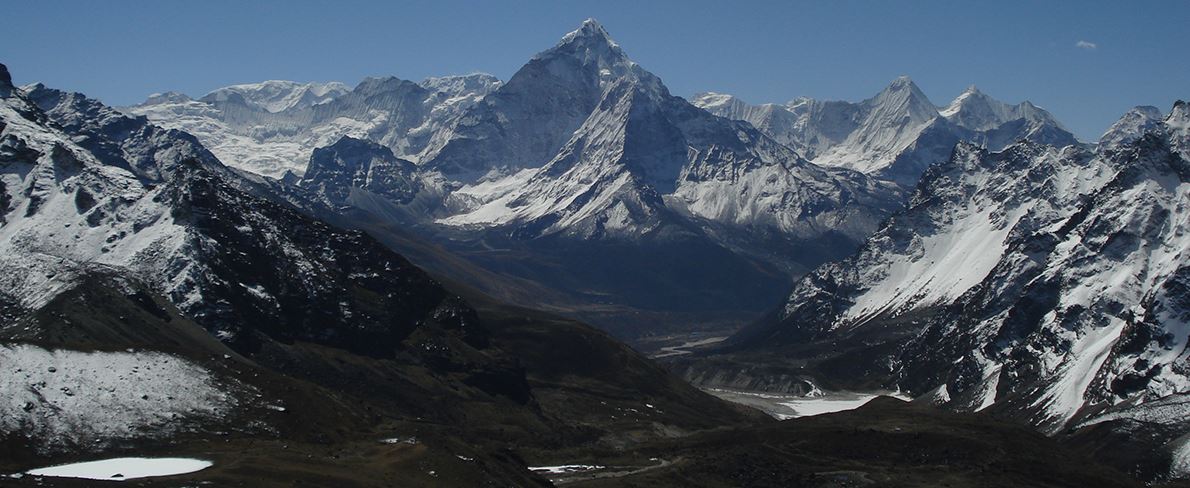
The Everest Three Passes Trek is one of the most demanding walking routes in the Khumbu, but its appeal comes from more than the three high passes named in the itinerary. The circuit links the major valleys of the Everest region, taking trekkers through Namche Bazaar, Tengboche, Dingboche, Everest Base Camp, Kala Patthar, Dzongla, Gokyo and the quieter settlements beyond the main Everest trail. Along the way, the route crosses Kongma La, Cho La and Renjo La, each with its own terrain, weather and character.
Unlike the Classic Everest Base Camp Route, which follows a largely linear trail before returning through the same valley, the Three Passes Trek forms a high-altitude circuit. You spend more time away from the busiest sections of the Khumbu and encounter a greater variety of landscapes, from pine and rhododendron forests around Namche to glacial valleys, moraine, rocky passes and the turquoise Gokyo Lakes.
The trek also demands more from the body. Several days involve substantial elevation gain, long descents and rough terrain, while the three passes all rise above 5,300 metres. Snow and ice can make the crossings considerably more difficult depending on the season. Good preparation matters, but so does the judgment of the people accompanying you. A route that looks manageable on a map can feel very different when the trail is covered in snow or when a long climb begins at high altitude.
For travelers who want to understand what the Khumbu feels like beyond the standard Everest Base Camp route, the Everest Three Passes Trek offers one of the most varied trekking experiences in Nepal.
Everest Three Passes Trek at a Glance
| Trek Information | Details |
|---|---|
| Trek Name | Everest Three Passes Trek |
| Region | Everest / Khumbu |
| Duration | 22 days on the current Nepal Himalayas Trekking package |
| Starting Point | Lukla |
| Ending Point | Lukla |
| Main Passes | Kongma La, Cho La and Renjo La |
| Highest Trekking Point | Kala Patthar, approximately 5,545 m |
| Everest Base Camp | Approximately 5,364 m |
| Gokyo Ri | Approximately 5,360 m to 5,483 m depending on the route/source |
| Difficulty | Challenging |
| Trek Type | High-altitude circuit trek |
| Accommodation | Tea houses/lodges, with facilities becoming simpler at higher elevations |
| Best Seasons | Spring and autumn |
| Guide Requirement | Licensed trekking guide required under current regulations |
| TIMS | Required under current Nepal Tourism Board provisions |
| Main Protected Area | Sagarmatha National Park |
The current Nepal Himalayas Trekking package describes the route as a 22-day journey incorporating Everest Base Camp, Kala Patthar, Gokyo Lakes and the three high passes.
What Makes the Everest Three Passes Trek Different?
The Three Passes route is not simply a longer version of the Everest Base Camp Trek. Its character comes from the way it connects several valleys and high mountain crossings into one continuous journey. After reaching the upper Khumbu, the trail can take you away from the conventional EBC corridor and across terrain where there are fewer settlements, fewer easy alternatives and more dependence on weather and trail conditions.
The three passes also give the trek a rhythm that ordinary valley trekking does not have. You spend days gradually preparing for a crossing, reach a high and exposed section, descend into another valley and then repeat the process. Between these difficult days are places such as Gokyo, where the pace slows around the lakes, and villages such as Thame and Marlung, where the landscape feels considerably quieter than Namche.
The route therefore rewards people who enjoy the journey itself rather than treating Everest Base Camp as the only objective.
Everest Three Passes Trek Route
A common circuit runs through Lukla, Phakding, Namche Bazaar, Tengboche, Dingboche, Chhukung, Kongma La, Lobuche, Everest Base Camp, Kala Patthar, Dzongla, Cho La, Thagnak or Gokyo, Gokyo Lakes, Renjo La, Marlung, Thame and Namche before returning to Lukla.
Exact overnight stops can vary according to the itinerary, weather, lodge availability and trail conditions. The order can also be arranged differently. What remains distinctive is the circuit itself: instead of simply walking to Everest Base Camp and returning along the same route, you cross the high passes and enter valleys that the standard EBC itinerary does not visit.
Lukla and the First Days on the Trail
The trek normally begins with the flight to Lukla. The small mountain airstrip immediately changes the atmosphere of the journey. From Lukla, the trail descends and follows the Dudh Koshi valley through settlements such as Phakding and Monjo before beginning the more substantial climb towards Namche Bazaar.
These lower days should not be dismissed as merely an easy introduction. The body is adjusting to walking with a trekking pack, the trail repeatedly rises and falls, and the sound of the river remains close for much of the journey. Suspension bridges, stone paths, mani stones, prayer flags and porters carrying supplies become familiar features of the trail.
The lower Khumbu is also greener than many first-time visitors expect. Pine, fir and rhododendron forests cover the slopes, while small cultivated plots appear around settlements. Nepal Tourism Board describes the vegetation of Sagarmatha National Park as changing with altitude, with pine and hemlock at lower elevations and silver fir, birch, rhododendron and juniper becoming more prominent above roughly 3,500 metres.
Namche Bazaar and Acclimatization
Namche Bazaar is where the trek begins to feel genuinely Himalayan. The village sits on a steep mountainside and functions as the main commercial centre for much of the Khumbu. Lodges, bakeries, shops, gear stores, cafés and small markets make it considerably more developed than the settlements you have passed through from Lukla.
More importantly, Namche is where acclimatization becomes a serious part of the journey. A well-planned itinerary includes time here before continuing higher. An acclimatization day does not mean spending the entire day in bed. A gradual hike towards the Everest View Hotel or surrounding viewpoints allows trekkers to gain some elevation during the day before returning to Namche to sleep.
The point is not to prove fitness. Walking too quickly during acclimatization defeats the purpose. A steady pace, adequate hydration, food and attention to how your body responds to elevation are more useful than trying to cover as much ground as possible.
If you want a shorter introduction to this part of the Khumbu, the Everest View Trek focuses on Namche, the Everest View Hotel and nearby Sherpa villages without continuing into the high passes.
Tengboche, Dingboche and the Approach to the High Country
From Namche, the trail continues towards Tengboche before climbing deeper into the Khumbu. The vegetation gradually becomes less dense as the altitude increases, and the mountains begin to dominate the landscape more completely.
Tengboche is particularly memorable because of its monastery and its position above the surrounding valleys. The settlement sits among mountain scenery that includes Ama Dablam, and the monastery remains an important spiritual centre for the local Sherpa community.
Beyond Tengboche, the landscape becomes increasingly alpine. Dingboche sits in a broad valley where stone walls divide fields and protect them from the mountain environment. At this elevation, nights become colder and the air noticeably thinner. The trail also begins to feel more exposed, with fewer trees and longer stretches of open ground.
This is an important psychological stage of the Three Passes Trek. The route has not yet reached its most difficult sections, but you are already walking in an environment where weather, altitude and pace matter considerably more than they did around Lukla and Namche.
Kongma La Pass
Kongma La is generally regarded as the highest of the three main passes, with route descriptions commonly placing the crossing around 5,500 metres. It connects the Chhukung and Lobuche sides of the Khumbu and involves a substantial climb over rough, high-altitude terrain.
The approach can feel deceptively quiet. There are fewer settlements, and the trail becomes increasingly rocky as you leave the inhabited valley behind. Depending on conditions, snow may cover parts of the route, making navigation and footing more difficult. The final climb can be particularly demanding because the air is thin and the slope offers little opportunity for an easy rhythm.
Reaching the top does not mean the difficult work has finished. The descent requires concentration, especially when loose rock, ice or snow is present. A strong guide is valuable here because the best route over the pass can change according to conditions.
The reward comes when the landscape opens around the summit. Ama Dablam, Makalu, Lhotse and other Himalayan peaks become part of a much wider panorama, while the valleys on either side demonstrate how dramatically the terrain has shaped the communities below.
Everest Base Camp
After the Kongma La section, the route reconnects with the main Everest corridor around Lobuche and Gorak Shep before continuing towards Everest Base Camp.
Everest Base Camp sits at approximately 5,364 metres and is one of the defining points of the trek. The landscape here is dominated by moraine, glaciers and immense mountain walls rather than forests or cultivated fields. The experience is also different from seeing Everest from a viewpoint. At Base Camp, the mountain is part of a much larger glacial environment, and the surrounding peaks and ice formations often make as strong an impression as Everest itself.
The actual appearance of Base Camp varies according to the season because it is a working mountaineering site rather than a permanent village. During climbing season, expedition tents and equipment can transform the area.
The Everest Base Camp Trek follows the classic route for travelers whose primary goal is Base Camp without adding all three high passes.
Kala Patthar
Kala Patthar rises above Gorak Shep and provides one of the most famous close views of Everest. The ascent is short compared with a full trekking day, but the altitude makes it considerably harder than the distance suggests.
The usual attraction is sunrise, when the mountains can take on changing shades as the light reaches the peaks. Everest, Nuptse and Pumori dominate the view, while the surrounding glacier and ridges provide the wider context.
The important point is that Kala Patthar is not simply another viewpoint reached by a casual uphill walk. At more than 5,500 metres, the body is working with significantly less available oxygen. A slow pace is sensible, particularly if the ascent follows several demanding days.
Cho La Pass
Cho La, usually listed at around 5,420 metres, connects the Everest side of the Khumbu with the Gokyo Valley. It is often considered the most technically awkward of the three passes because snow and ice can make the crossing more complicated.
The route between Dzongla and the pass involves a steady climb over rocky terrain before reaching the higher section. Conditions vary considerably. In a dry period, sections may be relatively straightforward, while recent snowfall can cover the trail and make navigation and footing more difficult.
The crossing also brings trekkers into the vicinity of the Cho La Glacier. This is one of the places where the difference between an ordinary trekking trail and a high-altitude mountain route becomes obvious. You may need more careful foot placement, and in some conditions traction equipment can be useful.
The descent towards the Gokyo side provides a dramatic change in scenery. After the stark terrain around the pass, the approach to the Gokyo Valley gradually introduces the glacial lakes and broad mountain basin.
Gokyo Lakes
The Gokyo Lakes are among the most beautiful features of the Everest region. Their intense colour contrasts with the surrounding rock, ice and snow, and the lakes sit beneath an impressive collection of Himalayan peaks.
Gokyo also provides something the Three Passes Trek does particularly well: a change of atmosphere. After several difficult high-altitude days, the lakeside settlement feels comparatively peaceful. Trekkers can walk around the valley, rest, photograph the mountains or climb Gokyo Ri depending on the itinerary and conditions.
The area is also associated with the Ngozumpa Glacier, one of the major glacial systems of the region. The relationship between the glacier, lakes and surrounding peaks gives the Gokyo Valley a character quite different from the Everest Base Camp corridor.
Gokyo Ri
The ascent of Gokyo Ri provides another major viewpoint. From the summit, the panorama includes Everest, Lhotse, Makalu and Cho Oyu among a much larger collection of peaks.
The climb is steep and the altitude makes the ascent slow. It is worth allowing the body time to settle into the effort rather than treating the summit as a race. On clear mornings, the view across the Gokyo Valley and Ngozumpa Glacier can be extraordinary.
For travelers particularly interested in scenery rather than Base Camp itself, the Gokyo Valley is one of the strongest reasons to choose the Three Passes circuit.
Renjo La Pass
Renjo La, generally around 5,360 metres, forms the final major pass of the circuit. The route climbs from the Gokyo side towards the pass before descending towards the quieter settlements of the Bhote Koshi valley.
The summit provides a remarkable panorama of the eastern Himalayas. Everest, Lhotse, Makalu and Cho Oyu can be visible in favourable conditions, although clouds and changing weather can obscure individual peaks.
Renjo La often feels different from the other two passes because of what lies beyond it. Instead of returning directly to the main EBC trail, you descend towards Marlung and Thame, entering a quieter part of the Khumbu where the villages and trails have a more remote character.
Thame and the Quieter Khumbu
Thame receives less attention than Namche, Tengboche and Everest Base Camp, but it adds considerable depth to the Three Passes experience. The valley has strong connections with Sherpa mountaineering history and remains an important settlement away from the main Everest route.
The quieter trail also changes the rhythm of the trek. There are fewer large groups and fewer commercial distractions, allowing more attention to the valley itself, the stone houses, fields, monasteries and movement of local people.
For trekkers who want to understand the Khumbu beyond the most photographed viewpoints, this section is one of the strongest arguments for taking the circuit route.
Sherpa Culture Along the Three Passes Route
The Everest region is not an empty wilderness surrounding the world's highest mountain. It is a lived-in cultural landscape shaped by generations of Sherpa communities.
You will encounter mani walls, prayer wheels, chortens, monasteries, prayer flags and houses built from local stone. The Buddhist influence is visible throughout the trail, but these features should not be treated merely as decorative scenery. They are part of religious practice and everyday life.
The Sherpa economy is also closely tied to the mountains. Lodges, porters, guides, yak and mule transport, agriculture and mountaineering support all contribute to life in the region. During the trek, the practical details of mountain living become visible: supplies arrive along trails, rooms are heated around dining areas, water has to be collected and transported, and everyday goods become more expensive as the distance from road access increases.
That is one reason the Three Passes Trek feels so different from an ordinary walking holiday. The trail is also a route through communities whose lives remain closely connected to the geography around them.
How Difficult Is the Everest Three Passes Trek?
The Everest Three Passes Trek difficulty falls firmly within the challenging category. Previous trekking experience is highly beneficial, particularly experience above 4,000 metres. The route does not require technical mountaineering in the conventional sense, but it includes steep climbs, high passes, loose rock, snow and potentially icy terrain.
The difficulty comes from accumulation as much as from any single climb. You may walk for several hours at altitude, descend significantly and then climb again the following day. The body has fewer opportunities to recover fully because oxygen availability remains low.
The three passes also behave differently according to weather. A dry trail in autumn can feel very different from the same route after a snowfall. Trekkers should therefore prepare for changing conditions rather than assuming that the difficulty described in a guidebook will remain identical on their departure date.
Who Should Consider This Trek?
The route suits people who already enjoy long days on mountain trails and are comfortable with sustained uphill and downhill walking. Previous high-altitude trekking experience is strongly useful because the route spends extended periods above 4,000 metres and includes multiple crossings above 5,000 metres.
You do not need to be an elite athlete. What matters more is endurance, patience, sensible pacing and the ability to keep walking when the terrain becomes uncomfortable.
If this would be your first Himalayan trek, a route such as the Everest Base Camp Trek or Everest View Trek may be a more appropriate introduction.
Altitude and Acclimatization
Altitude deserves serious attention on the Three Passes Trek. The route repeatedly reaches elevations above 5,000 metres, and even fit trekkers can experience symptoms of altitude illness.
Headache, unusual tiredness, dizziness, nausea and loss of appetite can occur. More serious symptoms require immediate attention and should never be treated as something to push through simply because a group has a schedule.
The itinerary should therefore include acclimatization stops, particularly around Namche and Dingboche. A gradual ascent gives the body more opportunity to adjust. Hydration, adequate food, sensible pacing and sufficient sleep all contribute to a safer and more comfortable trek.
The Nepal Tourism Board currently lists the Three Passes Trek among Everest-region routes where trekkers must be accompanied by a licensed trekking guide and carry an agency-issued TIMS card.
What Happens If You Develop Altitude Symptoms?
Tell your guide as soon as you notice something unusual. Mild symptoms may improve with rest and monitoring, but worsening symptoms should never be ignored.
The most important principle is that you should not continue gaining altitude when symptoms are becoming worse. Depending on the situation, the safest response may involve resting, changing the itinerary or descending to a lower elevation.
This is another reason not to treat the Three Passes Trek as a fixed sequence of kilometres and destinations. Mountain conditions sometimes require a different decision from the one printed on the original itinerary.
Best Time for Everest Three Passes Trek
The strongest trekking periods are generally spring and autumn, particularly when dry weather and clearer mountain visibility make the high passes more manageable.
Spring
March, April and May bring improving temperatures and increasingly stable conditions. Lower sections of the trail can also be attractive because rhododendrons begin flowering. April and May are popular months, although conditions at the highest passes can still include snow.
Autumn
September, October and November are traditionally among the most favourable months for trekking in the Everest region. October and November often provide crisp mountain visibility and dry trails, making them particularly attractive for high-pass trekking.
Winter
Winter trekking is possible, but the high passes become considerably colder and snow can make crossings difficult or temporarily impossible. Shorter daylight hours also reduce the margin available for difficult crossings.
Monsoon
June through August brings monsoon conditions to much of Nepal. Rain, cloud, muddy lower trails and flight disruptions can make the journey less predictable. The upper Khumbu receives less rain than many lower areas, but the approach to Lukla and changing mountain weather remain important considerations.
Nepal Tourism Board identifies October-November and March-May as the best seasons for Sagarmatha National Park and notes winter snow and summer rainfall as important seasonal characteristics.
Lukla Flights and Ramechhap
The flight to Lukla is one of the practical uncertainties of an Everest trek. Mountain weather can change quickly, and flights may be delayed or cancelled.
During busy trekking periods, flights to Lukla may operate through Ramechhap Airport at Manthali rather than Kathmandu. This can mean an overnight or early-morning road transfer from Kathmandu before the flight. Do not arrange your international departure immediately after your planned return from Lukla. Keeping spare days in Kathmandu gives you a much better buffer when weather or operational problems affect the flight schedule. The Nepal Tourism Board confirms Lukla as the principal air access point for trekking in Sagarmatha National Park, with road access from Jiri also possible for longer approaches.
Permits for Everest Three Passes Trek
The current permit requirements should be checked before departure because government regulations and fees can change.
For the Three Passes Trek, the main documents include the Sagarmatha National Park entry permit, Khumbu Pasang Lhamu Rural Municipality entry permit and TIMS card under the current applicable provisions.
The Nepal Tourism Board currently lists the Sagarmatha National Park entry fee for foreign visitors at NPR 3,000 per person.
The current TIMS provision lists the Three Passes Trek among routes requiring a licensed guide and agency-issued TIMS card. It currently lists TIMS at NPR 2,000 for non-SAARC trekkers and NPR 1,000 for SAARC trekkers.
Local entry fees can also apply. Khumbu Pasang Lhamu Rural Municipality entry permit entry fee for foreign visitors is at NPR 3,000 per person.
Everest Three Passes Trek Cost
The cost of a Three Passes Trek depends on the length of the itinerary, group size, guide and porter arrangements, accommodation, flights and the services included in the package.
Nepal Himalayas Trekking currently lists its 22-day Everest Three Passes Trek at USD 1,990 on the package page. Because commercial package prices can change according to season, group size, flight arrangements and included services, travelers should confirm the current quotation before booking.
Beyond the package price, budget for personal expenses such as drinks, snacks, charging, Wi-Fi, hot showers where available, tips, travel insurance and any unexpected accommodation or transportation caused by flight delays. If you want the current price for a particular departure date or group size, make an enquiry with Nepal Himalayas Trekking before making your travel arrangements.
What Does a Typical Day Look Like?
A typical day begins early because the higher sections of the route often require several hours of walking. Breakfast is followed by packing and a gradual start along the trail. The morning is usually the most productive walking period, particularly when a pass crossing or long ascent is involved.
Lunch is commonly taken at a tea house along the route when a suitable settlement is available. On higher or more remote sections, the choice can be more limited, and the day's timing may depend on the terrain rather than the location of a convenient restaurant.
Afternoons at altitude can bring cloud, wind and falling temperatures. Once you reach the night's lodge, the pace slows considerably. Trekkers generally gather around the dining room, eat, charge devices where possible and prepare clothing and equipment for the next morning.
The Three Passes Trek becomes easier psychologically when you accept this rhythm. The aim is not to fill every hour with activity. Much of the evening is simply about eating, warming up and preparing for another day in the mountains.
Tea Houses and Accommodation
Tea houses and lodges provide the main accommodation along the route. Rooms are generally simple, often with twin beds and shared bathroom facilities. As the altitude rises and settlements become smaller, facilities become more basic.
The dining room often becomes the social centre of the lodge. A stove or heater may provide warmth while trekkers from different countries compare routes, weather conditions and the day's experience.
At higher elevations, hot showers, charging and reliable internet may cost extra or may not be available. The simple accommodation is part of the reality of high-altitude trekking rather than a temporary inconvenience. A good sleeping bag is useful because nights can become very cold, particularly at the higher settlements.
Food on the Everest Three Passes Trek
Food along the route is more varied than many first-time trekkers expect, although the range narrows at higher elevations. Dal bhat, noodles, pasta, potatoes, soups, eggs, Tibetan bread and other simple meals are common.
Dal bhat remains a particularly practical trekking meal because it combines rice, lentils and accompanying vegetables and provides substantial energy. Tea, coffee and other hot drinks are also widely available.
Your appetite may decrease as you gain altitude, but regular meals remain important. If a particular food does not appeal to you, carrying a few familiar snacks can make the higher days easier.
Water and Hydration
Water is available along much of the route, but you should not assume that every source is ready to drink without treatment. Trekkers commonly use filtered, boiled or treated water.
Carry a reusable bottle or hydration system and plan your water supply according to the day's route. At higher elevations, dehydration can compound fatigue and make the walking feel considerably harder. Avoid relying exclusively on bottled water. Treating refillable water is generally more practical and creates less waste along the trail.
What to Pack for the Three Passes Trek
The packing list should reflect the highest and most difficult parts of the route rather than only the comfortable lower sections.
Warm layers, a waterproof outer layer, good trekking boots, gloves, a warm hat, sunglasses and sun protection are fundamental. A sleeping bag suitable for cold mountain nights is also strongly recommended.
For the high passes, trekking poles can provide useful stability, particularly on descents. Depending on current trail and snow conditions, microspikes or other traction equipment may be useful. Your guide should advise you according to the conditions immediately before the crossing.
You should also carry personal medication, basic first-aid supplies, a headlamp, water treatment equipment, spare batteries or a power bank, and copies of your important documents.
For a more detailed equipment reference, see the Everest Base Camp Trek packing list, while remembering that the Three Passes route requires additional preparation for high-pass conditions.
Travel Insurance and Emergency Evacuation
Travel insurance should specifically cover high-altitude trekking and emergency helicopter evacuation. A general travel policy that excludes trekking above a certain elevation may not provide adequate protection for this route.
Keep your policy details, emergency contacts and passport information accessible both online and offline. If a rescue becomes necessary, weather and aircraft availability can affect how quickly evacuation takes place.
A trekking agency can coordinate the practical arrangements, but insurance coverage and the insurer's approval process remain important parts of the process.
Is a Guide Necessary?
Yes. Under the current Nepal Tourism Board provisions, the Three Passes Trek falls among the Everest-region routes where trekkers must be accompanied by a licensed trekking guide and carry an agency-issued TIMS card.
On this route, the value of a guide goes beyond navigation. A knowledgeable guide can help assess changing trail conditions, monitor the group at altitude, communicate with lodges, manage changes caused by weather and help decide when a planned crossing should be reconsidered.
This matters most on the high passes, where a route that was straightforward yesterday may be affected by fresh snow or poor visibility today.
Porter Support
A porter can make a substantial difference on a trek of this length. Carrying only a daypack allows you to conserve energy for the repeated climbs and descents while your larger luggage is transported between lodges.
Pack responsibly and respect porter weight limits. The people carrying equipment along the Khumbu trails are working in the same difficult environment as trekkers, often over terrain where every kilogram matters.
How to Prepare for the Everest Three Passes Trek
Preparation should begin several weeks before departure. Long walks, stair climbing, hill walking and sustained cardiovascular exercise can help build the endurance required for consecutive days on uneven terrain.
If you live near hills, regular uphill and downhill walking is particularly useful. The Three Passes Trek involves much more than walking on a flat treadmill, so strengthening your legs and becoming comfortable with prolonged descents can be as important as improving cardiovascular fitness.
You should also practice walking with the footwear and daypack you intend to use. Discovering that your boots cause discomfort after several hours of walking is much better done at home than on the trail.
Insider Tips for Everest Three Passes Trek
Start Slowly
The excitement of reaching the Khumbu can make people walk too quickly during the first few days. Resist that temptation. The hardest sections are still ahead, and conserving energy from Lukla onwards pays dividends later.
Do Not Judge a Day by Kilometres Alone
A short distance can require several hours when the trail involves steep climbing, loose rock and high altitude. On pass-crossing days, elevation gain and terrain matter much more than the number shown on a map.
Keep Your Warm Layer Accessible
Weather can change quickly, especially on exposed sections. Do not bury your fleece, down jacket or rain shell inside your main luggage. Keep the layers you may need during the day within easy reach.
Protect Your Water From Freezing
At very high elevations during cold periods, water can freeze overnight or inside exposed bottles. Keep your bottle somewhere insulated and refill it before settling down for the night.
Carry Cash
Lodges and shops in larger settlements may accept cards or digital payments, but you should not depend on them throughout the circuit. Keep enough Nepalese rupees for personal expenses, charging, drinks and unexpected needs.
Download Important Information
Internet access becomes less reliable as you move away from larger villages. Save your insurance information, flight details, booking information and important contact numbers before leaving Kathmandu.
Watch the Weather Before a Pass
Do not think of a pass crossing as simply another day of the itinerary. Weather can alter the difficulty considerably. Your guide should assess conditions before committing the group to the crossing.
Leave Room in Your Schedule
Mountain flights and high-pass crossings do not always operate according to a city timetable. A flexible schedule is particularly valuable around Lukla and before your international flight home.
Eat Even When You Are Not Hungry
Altitude can suppress appetite, but the body still requires energy. Simple meals, soups, potatoes, rice and other easily tolerated foods can help maintain energy during long days.
Give Pack Animals Space
Mules, yaks and other pack animals use the same trails as trekkers. Move towards the mountain side when a train of animals approaches and avoid standing on the exposed outer edge of a narrow trail.
Do Not Hide Symptoms
If you feel unusually weak, dizzy, nauseous or short of breath, tell your guide. Trying to conceal symptoms to avoid slowing down the group can turn a manageable problem into a serious one.
Respect the Villages
The Khumbu is someone's home, not simply a trekking backdrop. Ask before photographing people, follow local customs around monasteries and religious objects, and avoid treating sacred sites as photo props.
Everest Three Passes Trek vs Everest Base Camp Trek
The Everest Base Camp Trek is the more straightforward choice for travelers whose main objective is reaching Everest Base Camp and Kala Patthar. The route follows the established Khumbu corridor and generally involves fewer high-altitude crossings.
The Three Passes route adds Kongma La, Cho La and Renjo La, along with Gokyo Lakes and Gokyo Ri. It takes longer, demands more physically and exposes trekkers to a broader range of terrain.
If your priority is the classic Everest journey, choose EBC. If you want a demanding circuit with high passes, glacial valleys and fewer repeated sections of trail, the Three Passes route offers considerably more variety.
Everest Three Passes Trek vs Gokyo Trek
The Gokyo Lake Trek focuses on the Gokyo Valley and its surrounding lakes and viewpoints. It can provide a quieter alternative to the classic EBC route without requiring all three high passes.
The Three Passes Trek incorporates Gokyo into a much larger circuit. You therefore experience the lakes as part of a journey that also includes Everest Base Camp, Kala Patthar and the three passes.
Other Popular Trekking Destinations in Nepal
The Three Passes Trek is not the right route for every traveler. Nepal offers several trekking destinations with different combinations of altitude, culture, landscape and difficulty.
Annapurna Base Camp Trek
The Annapurna Base Camp Trek reaches approximately 4,130 metres and passes through terraced hillsides, rhododendron forests, villages and the narrow Modi Khola valley. It provides a very different experience from the high-pass environment of Everest, with more vegetation and a lower maximum altitude.
Annapurna Circuit Trek
The Annapurna Circuit Trek crosses Thorong La and passes through several climatic and cultural zones. The route combines lower river valleys with high mountain terrain and is particularly rewarding for trekkers who enjoy long-distance journeys rather than concentrating on one famous destination.
Manaslu Circuit Trek
The Manaslu Circuit Trek offers a quieter Himalayan experience around Mount Manaslu. The trail follows the Budhi Gandaki valley through Gurung and Tibetan-influenced settlements before reaching the high Larke La. It provides the sense of remoteness that many trekkers seek without following the same landscape as Everest.
Langtang Trek
The Langtang Trek is particularly attractive when time is limited because the trailhead is accessible from Kathmandu by road. The route enters Langtang National Park and combines Tamang villages, forests, alpine meadows and mountain scenery around Kyanjin Gompa.
Kanchenjunga Trek
The Kanchenjunga Trek takes trekkers into the far eastern Himalayas around the world's third-highest mountain. It requires considerably more time and logistical commitment than many of Nepal's better-known routes, but the remoteness and quieter trails are part of its appeal.
Upper Mustang Trek
The Upper Mustang Trek offers an entirely different landscape, with dry cliffs, eroded valleys, monasteries, caves and settlements shaped by Tibetan Buddhist traditions. Its rain-shadow geography also makes it one of Nepal's notable trekking destinations during the monsoon period.
If you are uncertain which route fits your available time, previous experience and preferred level of difficulty, make an enquiry with Nepal Himalayas Trekking and discuss the options with the local team.
Is the Everest Three Passes Trek Worth It?
For an experienced trekker who wants more than the standard Everest Base Camp route, the answer can be yes. The circuit offers an unusual concentration of major Himalayan experiences within one journey: Everest Base Camp, Kala Patthar, Gokyo Lakes, Gokyo Ri, three high passes, Sherpa villages, monasteries, glaciers and long stretches of mountain trail.
Its difficulty should not be underestimated, however. The route demands time, patience and preparation. You cannot separate the spectacular scenery from the effort required to reach it.
The best reason to choose the Three Passes Trek is therefore not simply that it contains more attractions. It is that the route allows you to experience several different faces of the Khumbu within one continuous journey.
Frequently Asked Questions About Everest Three Passes Trek
How many days do I need for the Everest Three Passes Trek?
The current Nepal Himalayas Trekking package uses a 22-day itinerary including arrival, Kathmandu sightseeing, trekking, return to Kathmandu and departure. Different operators may offer shorter versions, but reducing days should not come at the expense of appropriate acclimatization.
What are the three passes on the Everest Three Passes Trek?
The three principal crossings are Kongma La, Cho La and Renjo La. Their exact elevations vary slightly among published sources and according to the point used for measurement, but all rise above approximately 5,300 metres.
Which is the hardest pass?
There is no universal answer because conditions change. Kongma La involves substantial climbing at very high altitude, while Cho La can become particularly awkward when snow and ice cover the trail. Renjo La also requires a long high-altitude ascent. Weather and recent snowfall can change the character of any crossing.
Do I need previous trekking experience?
Previous high-altitude trekking experience is strongly recommended. The trek is challenging because of its altitude, long walking days, steep climbs, descents and variable terrain.
Can beginners do the Three Passes Trek?
A physically fit beginner may be capable of the trek, but it is not the route I would recommend as a first Himalayan trekking experience. A shorter route such as Everest View or a standard Everest Base Camp itinerary provides a more gradual introduction.
Do I need a guide?
Yes. The Nepal Tourism Board currently lists Three Passes Trek among the routes requiring a licensed trekking guide and agency-issued TIMS card.
Do I need a TIMS card?
Yes. Under the current Nepal Tourism Board provisions, the Three Passes Trek requires an agency-issued TIMS card. The current listed charge is NPR 2,000 for non-SAARC trekkers and NPR 1,000 for SAARC trekkers.
What permits are required?
The route requires the Sagarmatha National Park entry permit, the applicable Khumbu local entry permit and TIMS under the current regulations. Nepal Tourism Board currently lists the Sagarmatha National Park entry fee for foreign visitors at NPR 3,000.
Can I do the trek without crossing all three passes?
If you want to avoid one or more passes, you should discuss an alternative itinerary with your trekking agency before departure. Weather and trail conditions can also require changes during the journey.
When is the best time for the Three Passes Trek?
Spring and autumn are generally the strongest seasons. October and November are particularly attractive for clear mountain views, while April and May offer good trekking conditions and spring vegetation at lower elevations.
Can I do the Three Passes Trek in winter?
It can be done in winter by experienced trekkers with appropriate preparation, but snow, cold temperatures and shorter daylight hours can make the high passes substantially more difficult.
Can I do the Three Passes Trek during monsoon?
It is possible, but conditions are less predictable. Rain and cloud affect the lower approach and Lukla flights, while high-pass conditions may change quickly.
What is the highest point of the trek?
Kala Patthar reaches approximately 5,545 metres, while the three passes themselves are also above 5,300 metres. The exact maximum depends on the itinerary and the points included in the route.
Is Everest Base Camp included?
The current Nepal Himalayas Trekking Three Passes itinerary includes Everest Base Camp and Kala Patthar.
Is Gokyo included?
Yes. The current route includes the Gokyo Lakes and Gokyo Ri before the Renjo La crossing.
How far is the Everest Three Passes Trek?
Published route distances vary according to the exact itinerary and whether side trips are counted. The current Nepal Himalayas Trekking material gives a walking range of approximately 135 to 162 kilometres.
What type of accommodation is available?
Tea houses and lodges provide accommodation throughout most of the route. Rooms become simpler at higher elevations, and shared bathrooms are common.
Is Wi-Fi available?
Wi-Fi is available at some lodges, particularly in larger settlements, but connectivity becomes less reliable in remote areas and may involve additional charges.
Can I charge my phone?
Charging is available at many lodges but may cost extra, especially at higher elevations. A power bank is useful.
Is hot water available?
Hot showers may be available at some tea houses, but they are usually charged separately and become less reliable or more expensive at higher elevations.
Do I need a sleeping bag?
Yes, a warm sleeping bag is strongly recommended because temperatures can become very low at higher elevations.
Can I hire a porter?
Yes. Porter support can be arranged through the trekking agency and is particularly useful on a long high-altitude circuit such as this.
What happens if my Lukla flight is cancelled?
Your trekking agency can coordinate with the airline and adjust the itinerary according to the next available flight and weather conditions. Keeping extra days before your international departure is strongly recommended.
Do I need travel insurance?
Yes. Choose a policy that specifically covers high-altitude trekking, emergency medical care and helicopter evacuation.
Can altitude sickness happen on the Three Passes Trek?
Yes. Because the route repeatedly climbs above 5,000 metres, altitude illness must be taken seriously. Tell your guide immediately if you develop concerning symptoms.
Plan Your Everest Three Passes Trek
The Everest Three Passes Trek asks more from a trekker than the classic Everest Base Camp route, but it also gives more in return. You cross three high Himalayan passes, enter the Gokyo Valley, stand at Everest Base Camp, climb Kala Patthar, walk through Sherpa settlements and experience sections of the Khumbu where the rhythm of the trail is shaped more by terrain and weather than by the number of trekkers passing through.
The route rewards preparation. Good boots, sensible clothing, physical conditioning and adequate acclimatization matter, but so do patience and the willingness to adapt when mountain conditions change.
Nepal Himalayas Trekking currently operates the route as a 22-day package and provides arrangements for guides, permits, accommodation, transportation and trekking logistics.
If you are comparing the Three Passes Trek with Everest Base Camp, Gokyo, Manaslu, Annapurna or another Himalayan route, make an enquiry with Nepal Himalayas Trekking. The local team can help you compare the routes according to your available time, previous trekking experience, preferred travel season and the level of difficulty you are prepared to undertake.
Explore More Trekking Routes in Nepal
For travelers still deciding where to trek, Nepal Himalayas Trekking also offers routes across the Everest, Annapurna, Langtang, Manaslu, Kanchenjunga and Mustang regions. You can explore the wider Everest Region trekking options or compare individual routes before choosing your itinerary.
Other useful options include the Annapurna Base Camp Trek, Annapurna Circuit Trek, Manaslu Circuit Trek, Langtang Trek, Kanchenjunga Trek, Upper Mustang Trek, Gokyo Lake Trek and the shorter Everest View Trek.
When you are ready to discuss dates, group size, route options or a private departure, send an enquiry to Nepal Himalayas Trekking and speak with the local team before finalizing your plans.
Add Your Comment